Research lines
Controlling selectivity, from metal catalysts to confined spaces
One question drives both lines: what decides which product a catalyst makes, and how fast? We answer it both in bulk solution and in confined spaces. Then we turn the answer into predictions that guide new catalysts in the lab.
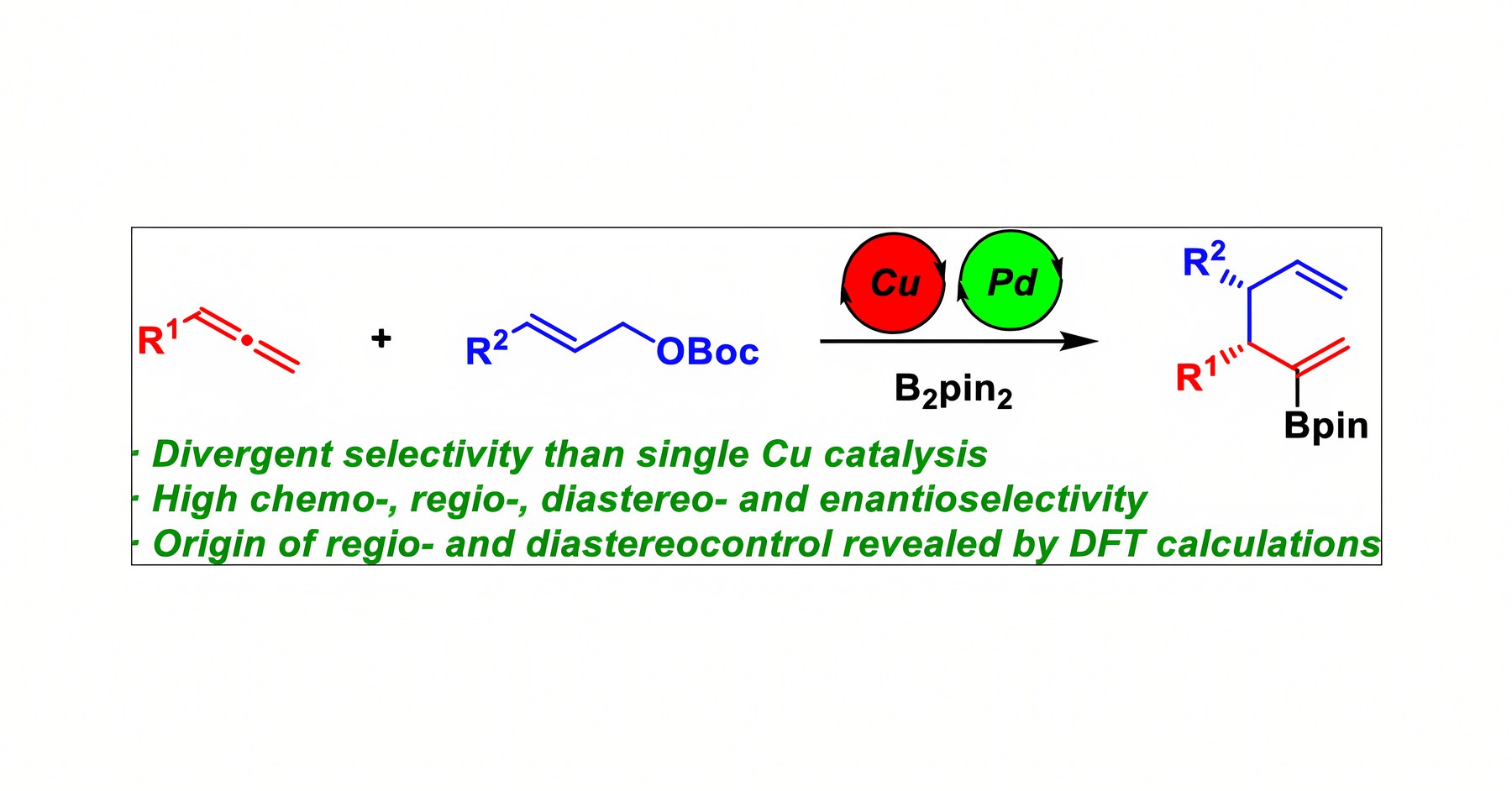
J. Am. Chem. Soc. 2024 · Synergistic Cu/Pd borylative coupling
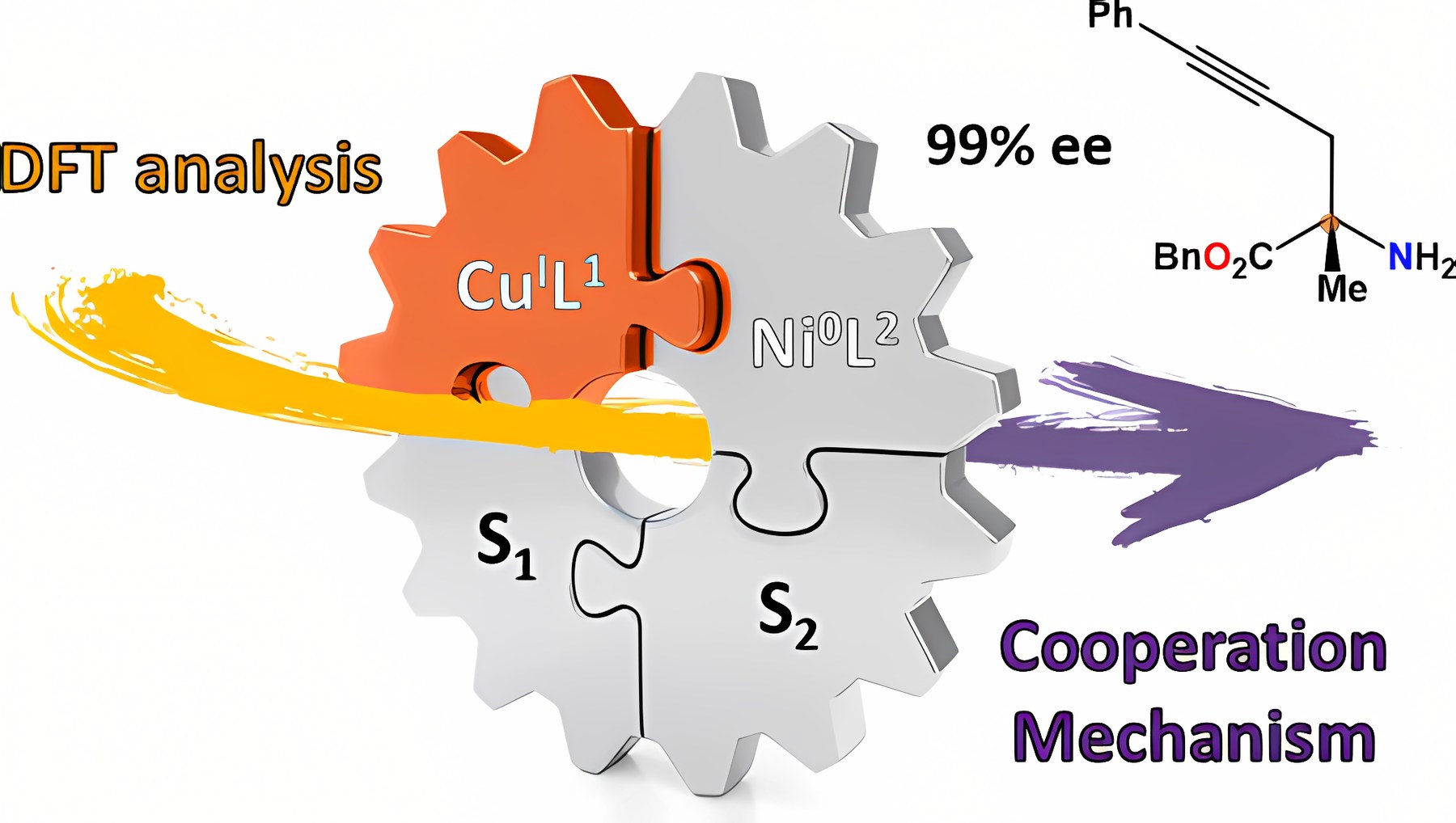
Chem. Commun. 2023 · Ni/Cu cooperative asymmetric propargylation
Ujaque · Sciortino
Homogeneous catalysis
Homogeneous catalysis is the group’s founding expertise, built over more than two decades with leading experimental groups. Our mechanistic studies of Pd-catalysed cross-coupling, including the role of the base in the Suzuki–Miyaura reaction, are widely cited references in the field, and the group was among the first in Spain to study gold catalysis computationally.
Today we move from explaining catalysts to designing them. Computation guided the most selective catalyst reported to date for the asymmetric hydrogenation of imines, and showed how two metals cooperate to reach selectivities that no single-metal catalyst achieves.
- Asymmetric hydrogenation of imines with Ir catalysts, where H-bonding and π–π contacts orient the substrate
- Anti-Markovnikov hydroamination with Au(I): the origin of regioselectivity
- Synergistic Cu/Pd and Ni/Cu catalysis; photocatalysis and first-row metals
- C–H activation and functionalization by metal carbenes and nitrenes
DFT · microkinetics · AIMD · explicit/implicit solvation
Ujaque · Sciortino
Supramolecular catalysis and metal–organic cages
The group is internationally known for explaining how metal–organic cages (MOCs) work as molecular flasks: confined spaces that change how a substrate reacts compared with bulk solution. Multiscale simulations show how guests enter, bind and react, and how preorganization, solvent, charge and cavity size shape the outcome.
- Why Prins and Nazarov cyclizations, key steps towards menthol and fragrances, run at neutral pH in water inside [Ga4L6]12−
- Diels–Alder reactions and C–C reductive elimination under confinement in [Pd6L4]12+ and [Ga4L6]12−
- Rocking and shuttling of guests in metalloboxes; guest binding in Au(I) metallo-tweezers
- Reversible assembly of triply interlocked Al6L4 and Ga6L4 cages
- The same ideas extend to protein-like scaffolds and artificial metalloenzymes, a line G. Sciortino also develops as a member of the InSiliChem group of Prof. J.-D. Maréchal (UAB)
MD · metadynamics · QM/MM · DFT
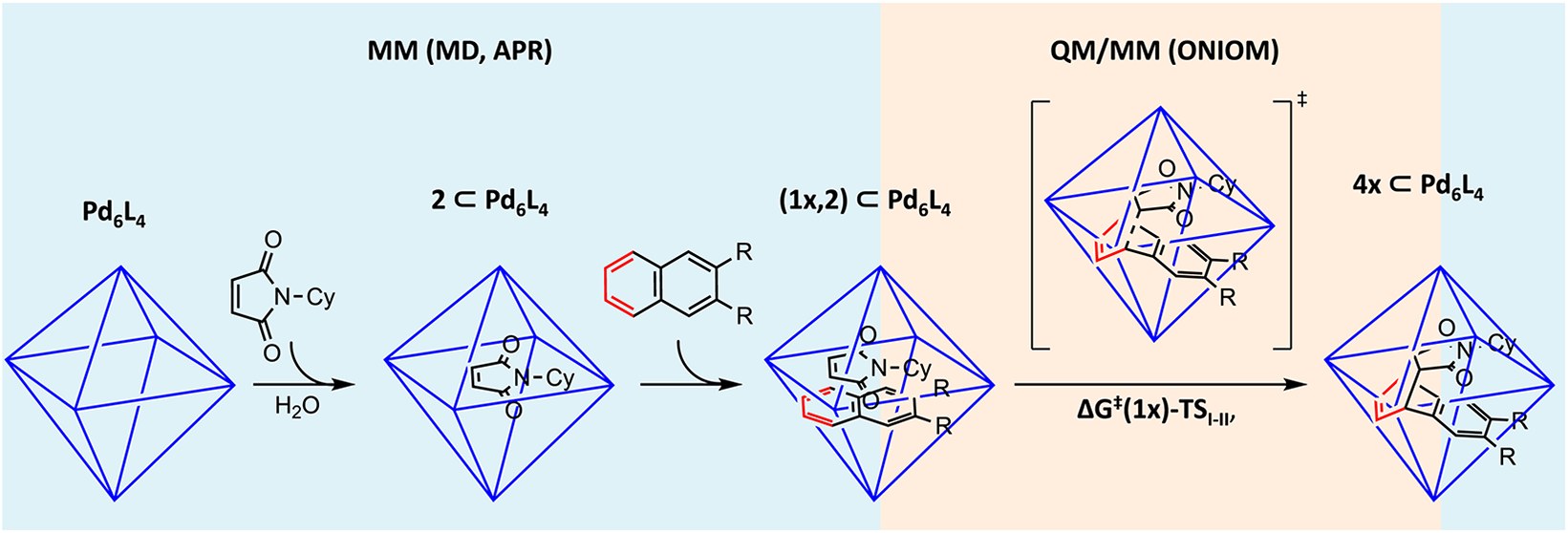
Inorg. Chem. 2026 · Diels–Alder reactions in [Pd6L4]12+
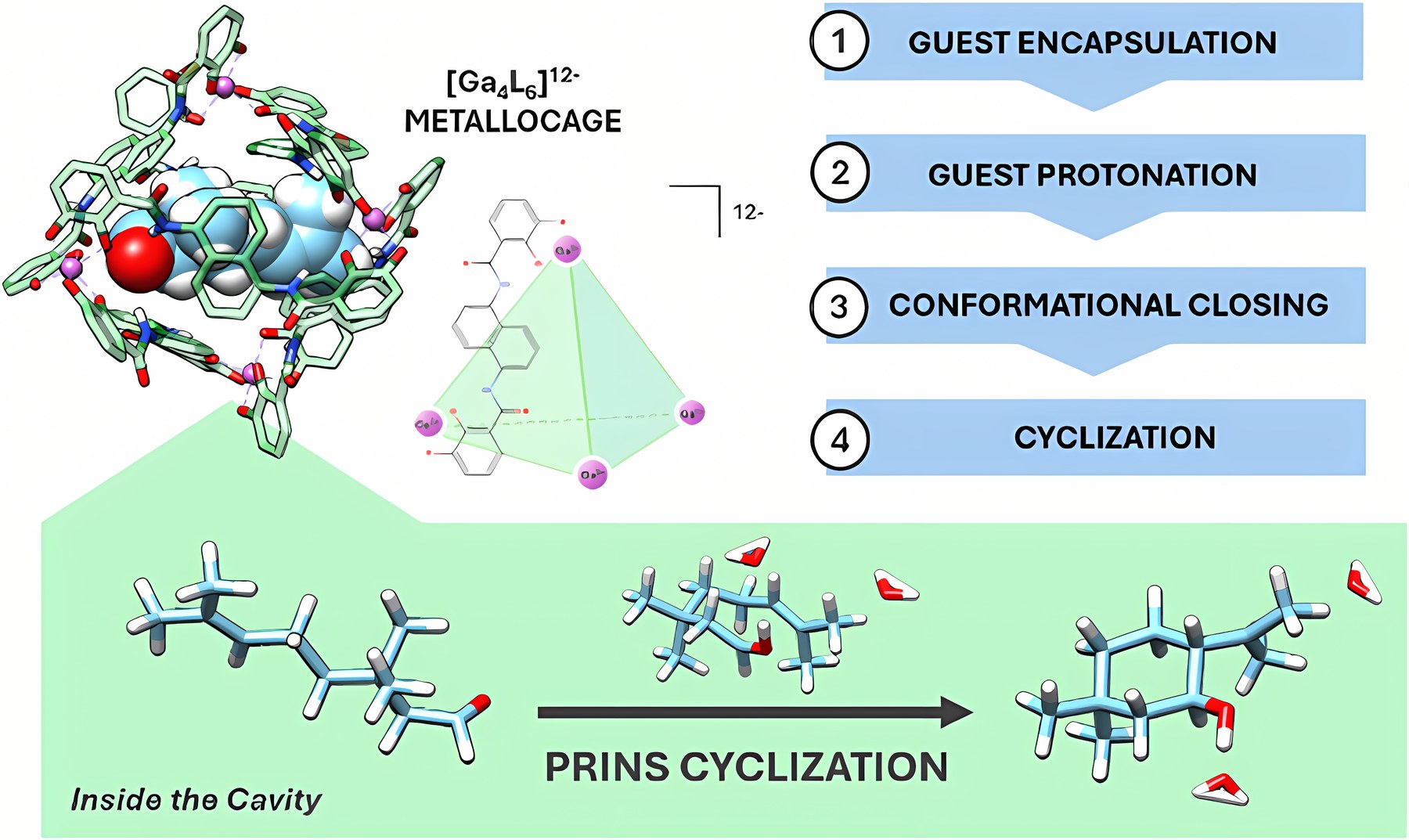
ACS Catal. 2024 · Prins reaction inside [Ga4L6]12−


