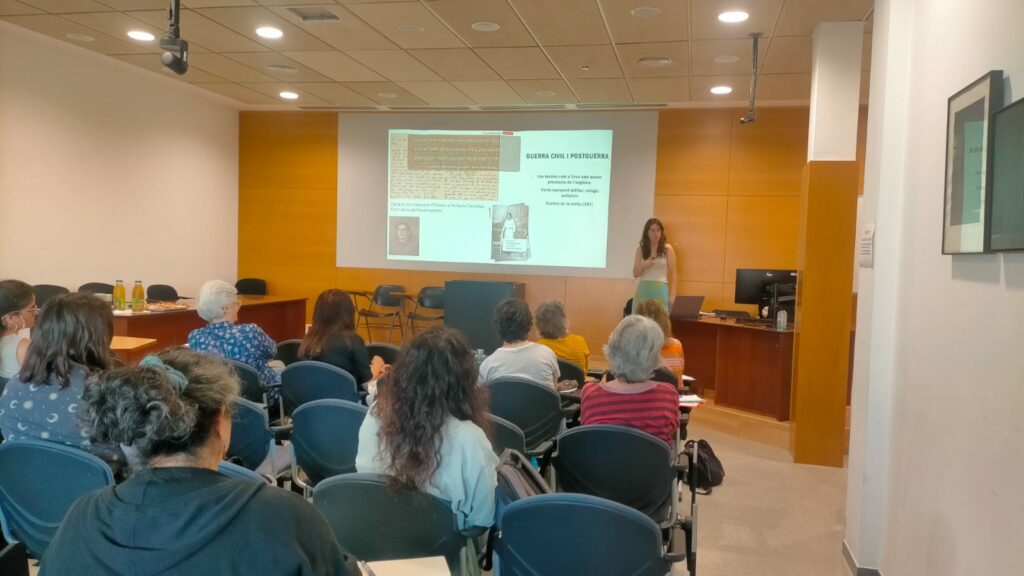
This Friday, May 22, 2026, the Geography and Gender Group hosted the seminar “Geography of feminist memory in the farmhouses of a historical cross-border region between Castellón, Tarragona and Teruel,” delivered by Núria Salvador, a geographer from the University of Valencia and currently a PhD candidate in gender, rural and mountain geography.
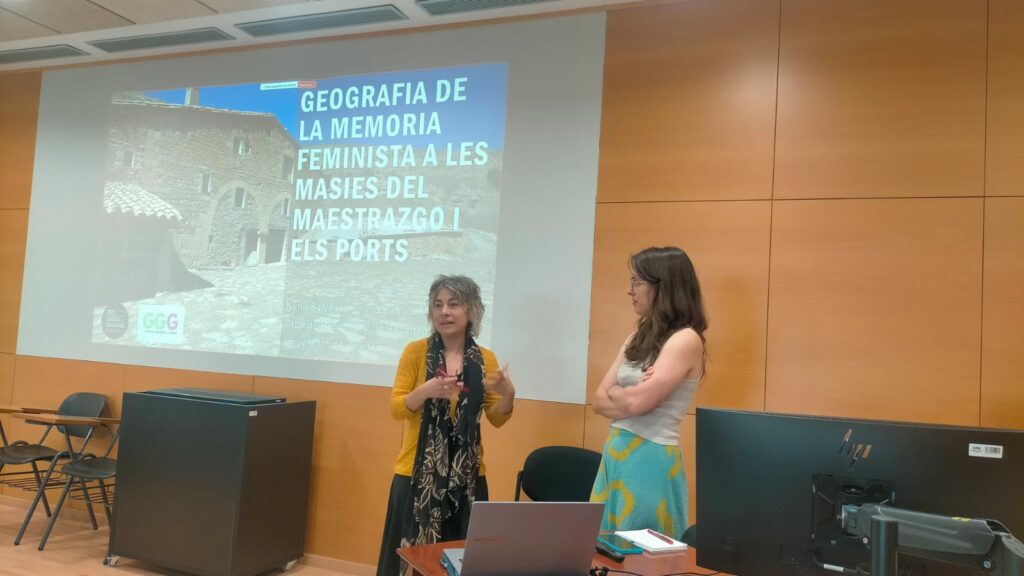
Núria Salvador, who is also a substitute lecturer in the Department of Geography at the University of Valencia and a member of the Research-Action group Recartografías, presented research situated in the fields of geography of memory, rurality, and gender. Her intervention highlighted the importance of revisiting dominant historical narratives, often shaped by power biases, in order to recover invisible perspectives, especially in relation to the rural world and women’s experiences.
The seminar focused on the masovera societies of the regions of Gúdar-Javalambre and Maestrazgo (Maestrat-Els Ports), a cross-border territory where the farmhouse has historically been the basic unit of settlement. Based on work developed with the Recartografías group, the speaker put forward the hypothesis that, in these contexts, the patriarchal model of the nuclear family associated with capitalism has not been implanted in the same way as in urban environments or concentrated population centers.
According to the research, factors such as the persistence of forms of communal governance, the relevance of common goods, or the lack of a strict separation between productive and reproductive work have shaped specific social dynamics. Within this framework, the feminist perspective is incorporated transversally to analyze the sociocultural construction of gender, highlighting the interrelation between patriarchy and the capitalist system of production.
Methodologically, the work combines interviews with women born in farmhouses in the Cantavieja river valley with the review of historical archives—such as marriage contracts, epistolary material, religious documents, or schoolbooks—which allow for a long-term perspective, from the late 19th century to the present.
The seminar generated a rich discussion on the potential of feminist geography to reinterpret rural spaces and recover often-silenced memories, thus contributing to broadening narratives about the territory and its ways of life.
From the Grup de Geografia i Gènere, we thank Núria Salvador for her participation and her valuable contribution to the critical reflection on rurality, memory, and gender.