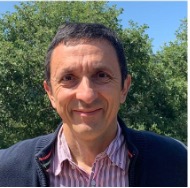
I carry out my research within the Logistics and Aeronautics Unit of the Department of Telecommunications and Systems Engineering, with a focus on causal modelling, discrete event simulation, and spatio-temporal analysis methods aimed at socio-technical challenges.My research interest is the systems thinking approach to uncover the causes of hidden dynamics, and the design of new mechanisms to improve industrial and transport KPIs considering a human-centric approach.
My research is structured around causal modelling, discrete event simulation, and spatio-temporal analysis methods, with a particular focus on Air Traffic Management (ATM) and new designs on Adaptive Automation considering a human-centric approach. I am especially interested in the quantitative and qualitative analysis of human factors in very demanding operational context, and the design of new mechanism relying on an innovative modeling framework that integrates process, functions, layout and humans.
A core objective of my research is the use of a systems thinking approach to improve the key parameter indicators considering different trade-off solutions.My recent research focuses on Air Traffic Management, addressing challenges such as Flight Formation for commercial aircraft, Dynamic Airspace Configuration, Pilot-Cockpit interaction and Airport Operations.
My research has generated both significant scientific contributions and operational solutions that have been adopted in real industrial and institutional settings. From a scientific perspective, I have published extensively in leading international journals and conferences in the fields discrete event simulation, manufacturing and air traffic management, providing new solutions to improve different industrial KPIs.
From an applied standpoint, my work has led to the development of decision-support tools that integrate causal simulation models and spatio-temporal analysis, that have been successfully deployed in manufacturing and transport domains. While some of these results could not be fully disseminated due to industrial confidentiality constraints, their relevance and impact have been validated by both industrial partners and public institutions.
My research outcomes also include award-winning publications, books, a granted European patent, registered software assets, and the supervision of several doctoral theses.
Technology transfer has been a central pillar of my academic and professional trajectory. I’ve been co-founder of three spin-off companies, and I’ve received several recognitions such as the Society for Computer Simulation award: “Outstanding Professional Contribution Award, 2013” (http://www.scs.org/documents/SCS_awards.pdf).
I have participated as a researcher, scientific advisor, and principal investigator in numerous national and European technology transfer projects, particularly within the SESAR, FP6, FP7, Horizon 2020, and Horizon Europe frameworks. These projects have led to the development of simulation models, licensed software solutions, and patented technologies that are currently exploited in operational environments, including airport security screening systems.
My technology transfer activities encompass licensed software, patents under active exploitation, long-term industrial agreements, and public–private research contracts. They are supported by close collaboration with key stakeholders such as aviation authorities, airports, industrial partners, and European institutions. Collectively, these efforts demonstrate my sustained commitment to delivering research-driven innovation with measurable industrial and societal impact.
My teaching interests are closely aligned with my research activities and span systems thinking, modeling, simulation, logistics, and air transport management. I am particularly committed to engage students with real industrial problems using a systems thinking approach.
I have extensive experience in curriculum development and academic leadership, including the coordination of undergraduate programs in Aeronautical Management. In addition, I have supervised numerous doctoral dissertations and final projects focused on modeling, simulation, and decision-support systems applied to complex operational contexts.
In the classroom, I promote an applied, systems-oriented learning approach that encourages students to adopt a holistic perspective on complex systems while developing rigorous analytical, computational, and problem-solving skills.
Link to main research outcomes
miquelangel.piera@uab.cat
Office: 262
C/ dels Emprius nº 2
Campus de la UAB · 08202 Sabadell
Barcelona · Spain