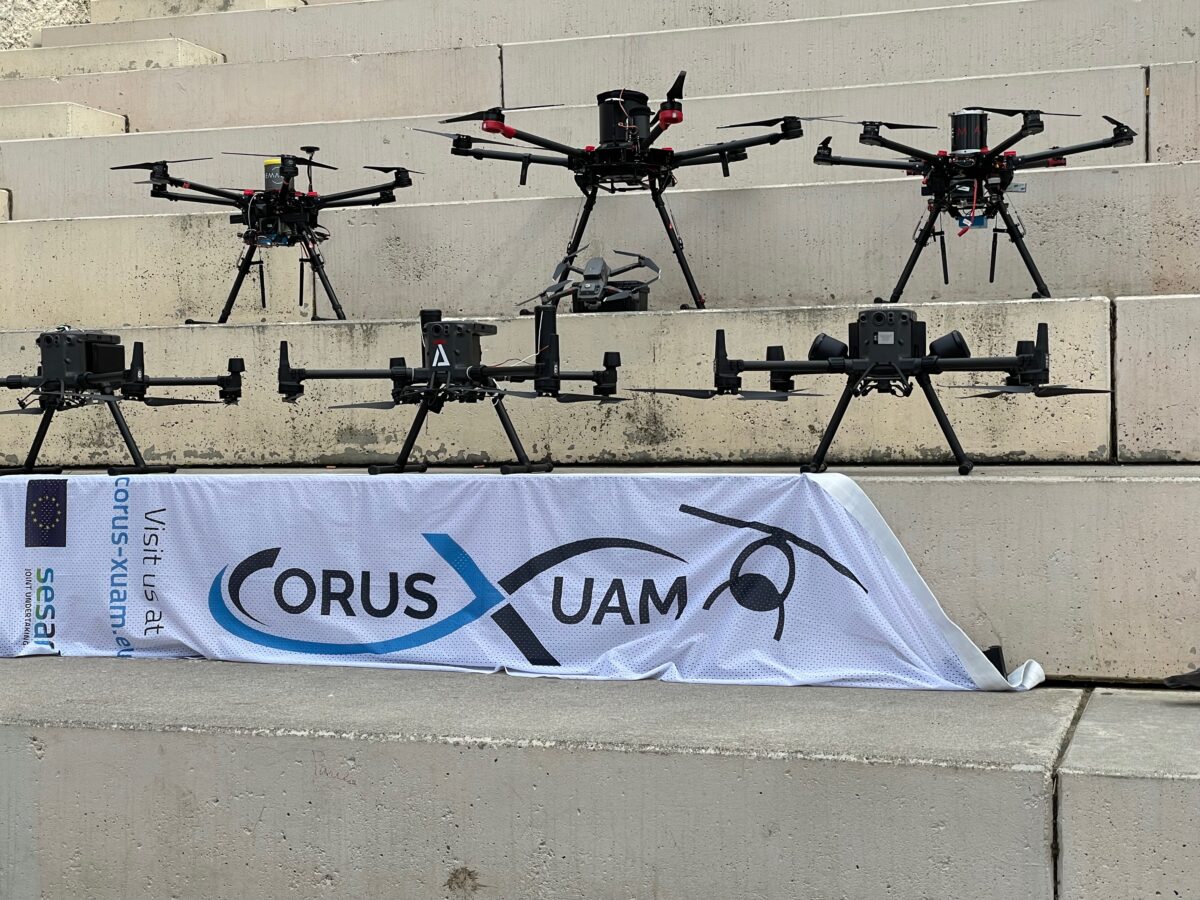
CORUS‑XUAM is a 24‑month Very Large Demonstration (VLD) project that showcases how U‑space services can enable integrated Urban Air Mobility (UAM) operations in Europe. The project demonstrates how eVTOLs, drones, and manned aircraft can operate safely, securely, sustainably, and efficiently within a fully integrated airspace, without negatively affecting existing ATM operations.
Building on the original SESAR CORUS U‑space Concept of Operations (ConOps) delivered in 2019, CORUS‑XUAM extends the framework to address the specific needs of UAM operations, including the identification of new U3 and U4 U‑space services. The project begins with an update of the ConOps to support the integration of UAM and UAS into controlled and uncontrolled airspace.
At the core of the project are six challenging VLD campaigns conducted at six European locations. These demonstrations validate integrated operations involving UAM, UAS, and manned aviation through advanced digital data exchange and U‑space services in urban, suburban, and inter‑city environments, as well as in and around ATM‑controlled airspace and major airports.
The VLDs cover a wide range of missions, including passenger transport, logistics, delivery, emergency response, and surveillance, and demonstrate key capabilities such as vertiport procedures, separation services, data services, and coordination between ATC, pilots, and U‑space actors. The results are used to further consolidate the ConOps and are supported by continuous engagement with authorities, stakeholders, and end users, contributing to the future deployment of UAM in Europe.
In this project, Aslogic, our startup spin-off, acted as the USSP technology partner, while our research group also operated as a drone operator, supporting real flight operations. This setup enabled full end-to-end validation of U-space services, directly linking research, industrial deployment, and operational use, ensuring direct technology transfer from academia to real-world operations and reinforcing the market readiness of the proposed solutions.