Advancing the Internet of Medical Things
The Internet of Medical Things (IoMT) is reshaping the future of healthcare. By enabling remote patient monitoring, IoMT systems make it possible to track chronic conditions in real time and detect early signs of potential health issues. At the core of this transformation are wearable sensors, which collect physiological and environmental data directly from the human body or medical surroundings. As the Principal Investigator (PI) of the IoMT project, funded by the UOC-eHealth, I am working to advance this field by developing innovative, accessible, and energy-efficient technologies for continuous health monitoring.
Why Sweat Matters in Medical Monitoring
Among the many types of biosignals and biomarkers, human sweat is gaining attention for its diagnostic potential. Sweat contains valuable biochemical information and provides insight into hydration levels, thermoregulation, electrolyte balance, and stress responses.
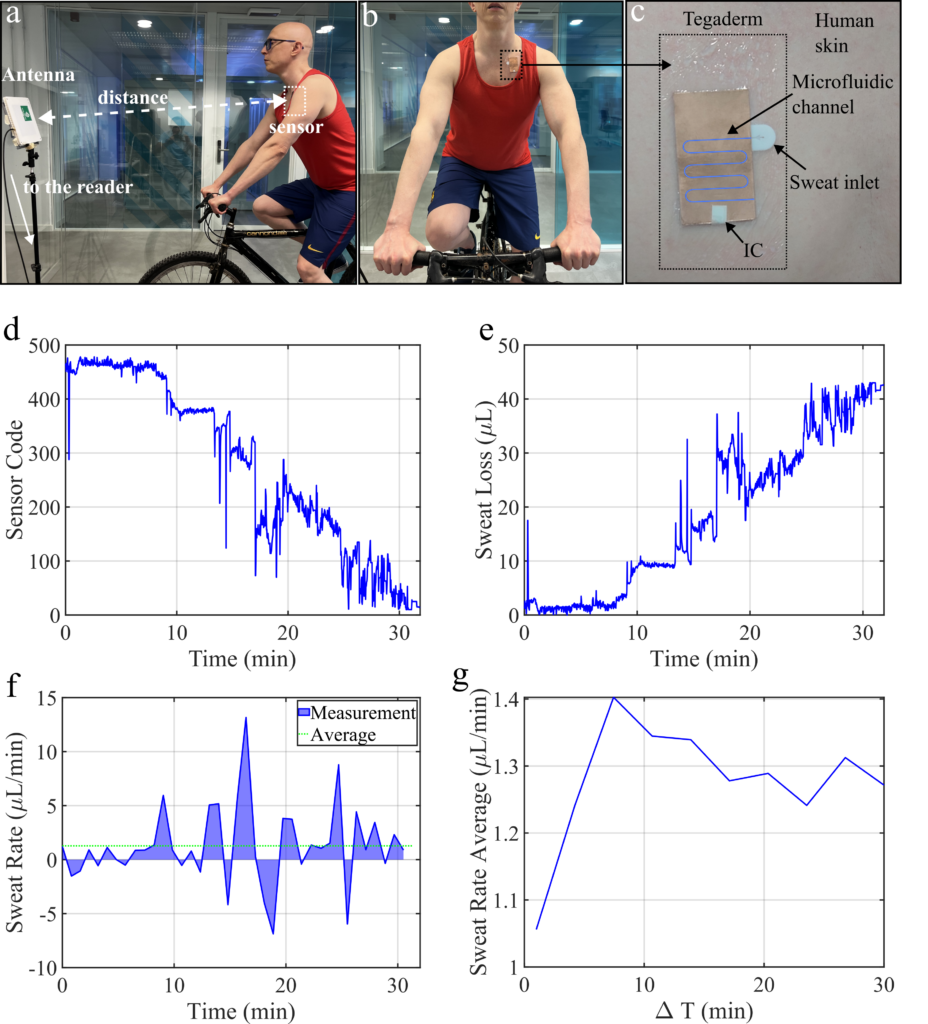
Sweat Loss Measuring Devices (SLMD) are particularly relevant, as they can support the early diagnosis of chronic diseases, heat-related illnesses, and disorders affecting thermoregulation. Moreover, accurately measuring sweat rate is essential for reliable interpretation of other sweat biomarkers.
However, existing SLMDs come with an important limitation.
The Challenge: Power-Hungry Wearables
Most current wearable SLMDs rely on electronic components powered by batteries. This creates several problems:
- Limited operating time
- The need for human supervision to replace or recharge batteries
- Increased cost and environmental impact due to battery production and disposal
- Reduced accessibility for populations in developing regions, where high temperatures make monitoring even more critical
To overcome these drawbacks, we need a new generation of wearables—devices that work without batteries, that are affordable, and that can be deployed at scale.
Backscatter Technologies: A Path Toward Battery-less IoMT Devices
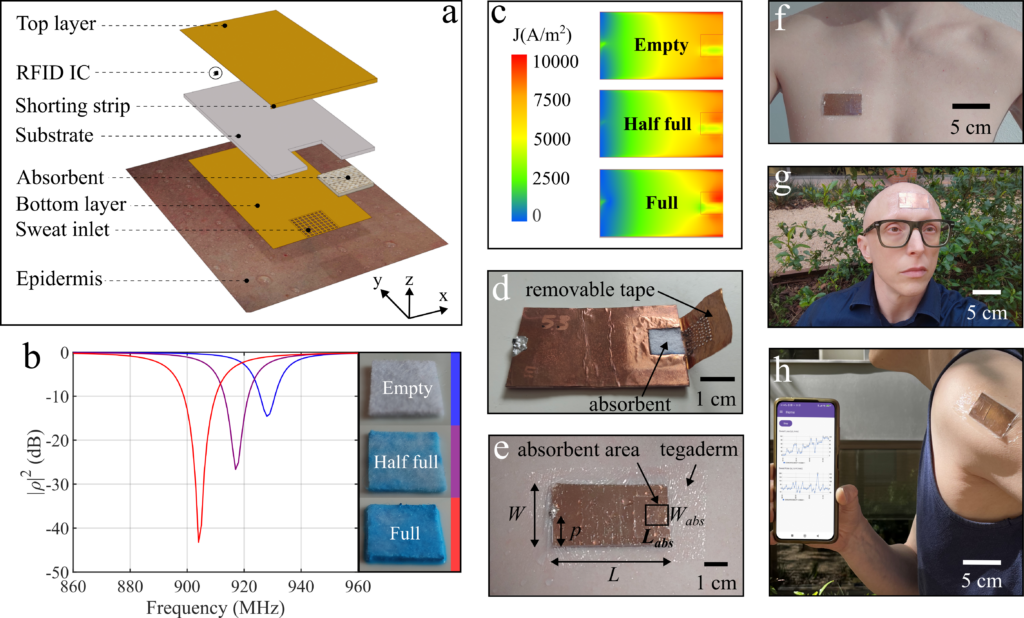
Backscattering communication technologies provide a promising solution for massive IoMT deployments at very low operational cost. In particular, ultra-high frequency (UHF) RFID antenna-based sensors (ABS) can enable battery-less, low-cost SLMDs.
Yet, traditional RFID sensing methods face significant limitations:
- Low accuracy due to poor linearity in the sensor response
- Sensitivity to position and orientation during the entire measurement cycle (around 30 seconds)
- Frequency bandwidth constraints that limit range and resolution
Toward Scalable, Sustainable, and Accessible Healthcare Technology
Ultimately, this IoMT project aims to push forward a new model of health monitoring that is:
- Continuous
- Battery-less
- Low-cost
- Environmentally sustainable
- Accessible to vulnerable populations
By reducing dependence on batteries and leveraging efficient backscatter-based sensing, we hope to make reliable health monitoring available to broader communities, including those in high-temperature regions where heat stress poses a serious health risk.