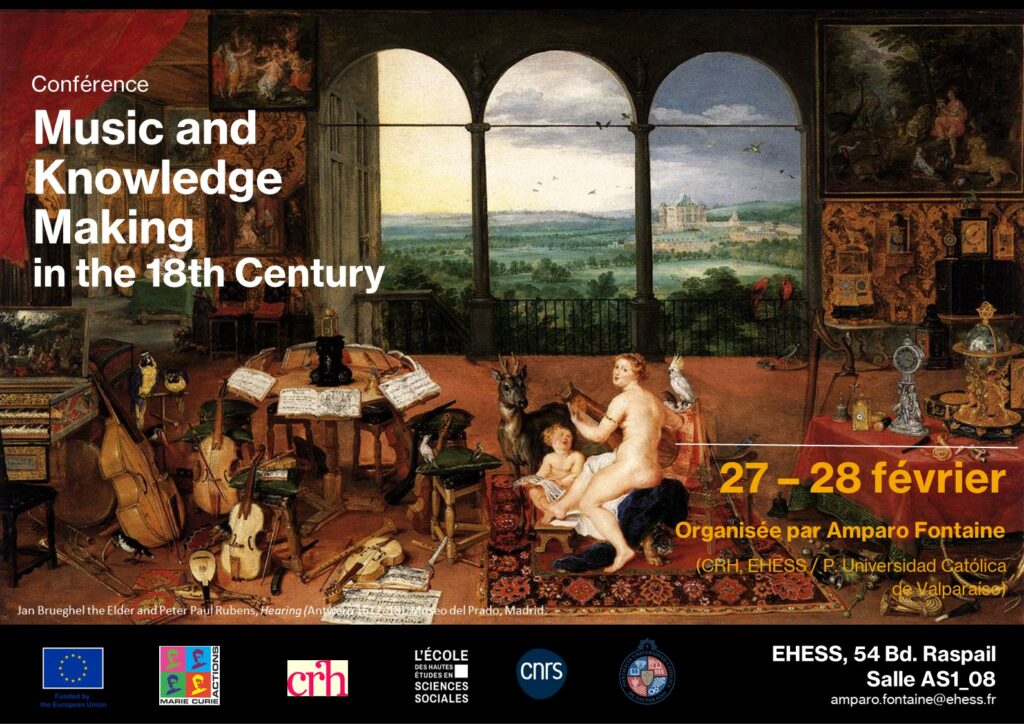
In February 2025, the conference “Music and Knowledge Making in the 18th Century”, organized by Dr. Amparo Fontaine (EHESS, P. Universidad Católica de Valparaíso) at L’École des hautes Études en Sciences Sociales (EHESS). Elena Serrano was invited to present her research.
Abstract of Elena Serrano's presentation:
Music and the Physiology of Emotions at eighteenth-century Hispanic World.
This paper explores the role of sound and music in the production of scientific knowledge about the physiology of passions. In particular, it investigates how the celebrated natural philosopher Benito J. Feijoo (1676–1764) explained the arousal of love through the vibrations of nerves.
One of the most influential writers in the Hispanic world, Feijoo sought to explain how the impressions of the external world captured by the senses could come to provoke internal passions and movements of the soul. My paper suggests that Feijoo’s deep knowledge of the nature of sound, his observations and readings about music’s influence on mood and health, and above all, the intense feelings that music aroused in him, influenced his view on the physiology of emotions. According to the historian Antonio Martín Moreno, Feijoo appealed “innumerable times” to music to explain his opinions. I would add that he recurred to music especially to conceive and explain the relationship between soul and flesh in a way that resonated deeply with his numerous readers. The paper will bring into dialogue works on music and related genres (such as musical treatises and compositions) that circulated widely in the Hispanic context with medical and philosophical treatises and practices of musical healing. My ultimate aim is to address the role of intersensory, affectional, and gender experiences in the production of knowledge.
Read more about the conference:
Music and Knowledge Making in the 18th Century
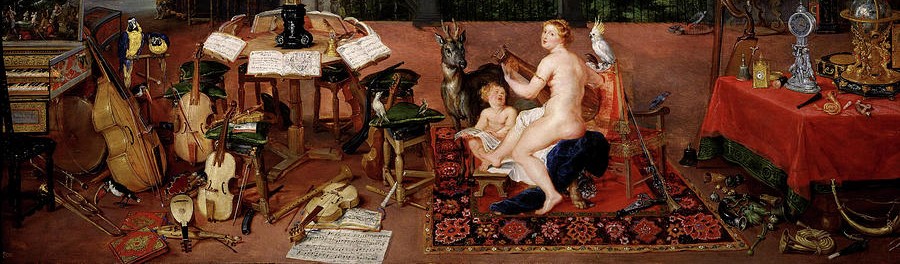
This conference brings together historians working on music and the sciences in the eighteenth century, to discuss the varied approaches to music as both a source and a tool of knowledge in this period. It aims to critically explore what eighteenth-century authors meant by referring to music as a science and discussing it within the leading scientific academies. Yet it also seeks to address a series of practices that flourished outside the academies and are not included in traditional histories of the ‘science of music’. Drawing on recent re-evaluations of the roles of commerce, artisanal and material practices in the creation and negotiation of knowledge, the conference will investigate the extent to which musical instruments were viewed as scientific instruments and embodiments of knowledge. It will also highlight the significance of music in the study of the body—ranging from medical sciences to performance—and its role in the gradual emergence of the human sciences during this period, particularly in the context of early anthropological and ethnographic research.
By integrating a diverse array of fields, practices, and geographical perspectives on knowledge-making, the conference aims to foster interdisciplinary and collaborative discussions on the scientific claims, methodologies, and challenges that shaped the interplay of music and knowledge during the Enlightenment. Discussions on how different epistemic models of music were confronted and negotiated across disciplines and cultures are particularly welcomed.