URBAG participation at EGU25

URBAG took part in the EGU General Assembly 2025 in Vienna, where researchers presented their latest work on urban air quality, greenhouse gas fluxes, and nature-based solutions for climate adaptation. Three contributions by Qing Luo, Ricard Segura-Barrero and Svetlana Khromova showcased URBAG’s interdisciplinary approach to tackling climate challenges in urban environments.

New preprint: Assessing the Short-Term Air Quality Health Impact from Land-Use Changes During Heatwaves

Title: Assessing the Short-Term Air Quality Health Impact from Land-Use Changes During Heatwaves: A Health Impact Assessment in Barcelona Metropolitan Area / Heatwaves amplify air pollution, increasing public health risks, particularly in urban areas where land use influences the distribution of pollutants. This study examines the short-term health effects of air pollution during a two-week heatwave in the Barcelona Metropolitan Area under different land use scenarios

New preprint: “A Social-Ecological-Technological Vulnerability Approach for Assessing Urban Risks”

Title: A Social-Ecological-Technological Vulnerability Approach for Assessing Urban Risks. Case Study of the Hydrological System of Barcelona, Spain / As urban populations continue to increase throughout the 21st century, a greater number of people are anticipated to face risks associated with extreme climate events. This study explores the intricate nature of water-related risks to urban communities through a Social-Ecological-Technological Systems framework.

ERC report: Transformative change for a sustainable future

In December, the European Research Council (ERC) published a groundbreaking report addressing this vital question. URBAG joined forces with over 300 ERC-funded projects to shed light on the concept of transformative change and its potential to create a just and sustainable future. The report explores strategies to scale up sustainability while protecting the environment.

New preprint: “Effect of Land Use Changes on Air Quality: Impacts of Urbanization, Urban Vegetation, and Agriculture”

Title: Effect of Land Use Changes on Air Quality: Impacts of Urbanization, Urban Vegetation, and Agriculture / Rapid urbanization in urban areas is transforming natural landscapes into impervious surfaces, resulting in changes to the physical properties of these surfaces. Changes in surface physical properties impact local temperature and convection, which in turn affects air quality.

URBAG presentation at the CONEXUS Conference

Svetlana Khromova presented the first step of an integrated approach to informed Nature Based Solutions (NBS) at the CONEXUS Conference. The CONEXUS conference took place in Barcelona from May 15th  to 17th, which aims to share the knowledge about nature-based urban solutions as a tool for urban planners.

URBAG participation at EGU24

Two URBAG presentations were shared at the conference by Ricard Segura-Barrero and Sergi Ventura. Both presentations followed the platform for Early Career Scientists (ECS). The first one was presented by Ricard Segura in the session "Urban climate, urban biometeorology, and science tools for cities". The second, presented by Sergi Ventura, was held in the session "Regional to local climate change, processes, impacts, and extremes".

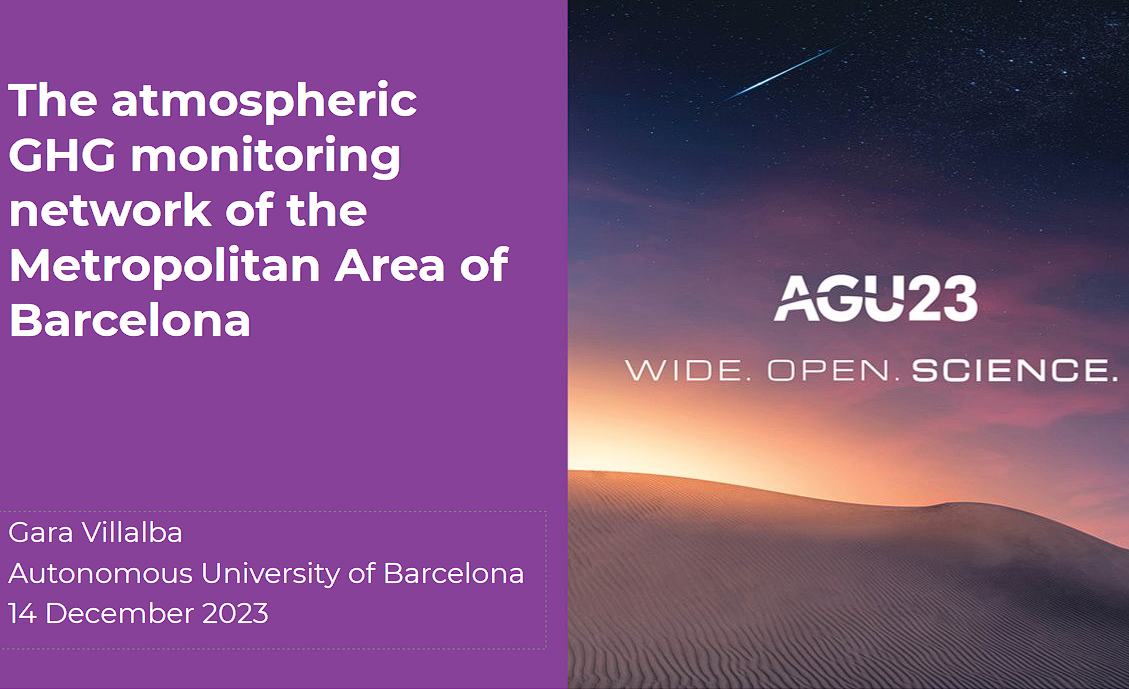
URBAG participation at AGU23

As every year, the AGU Annual Meeting has taken place, bringing together more than 25,000 participants from over 100 countries. Scientists, policymakers, communicators... Everyone is welcome to share science and try to better understand our planet and environment. This year, thanks to the hybrid model that capitalizes on both personal and virtual participation, Gara Villalba presented her work.

Participation at the Green urbanism conference

On December 2023, URBAG participated at the VII International conference on Green Urbanism (GU 2023) with the presentation “Integrated System Analysis of Urban Vegetation and Agriculture: An Interdisciplinary and Participatory Decision Approach for Evaluating Nature-based Solutions Against Urban Vulnerabilities”.