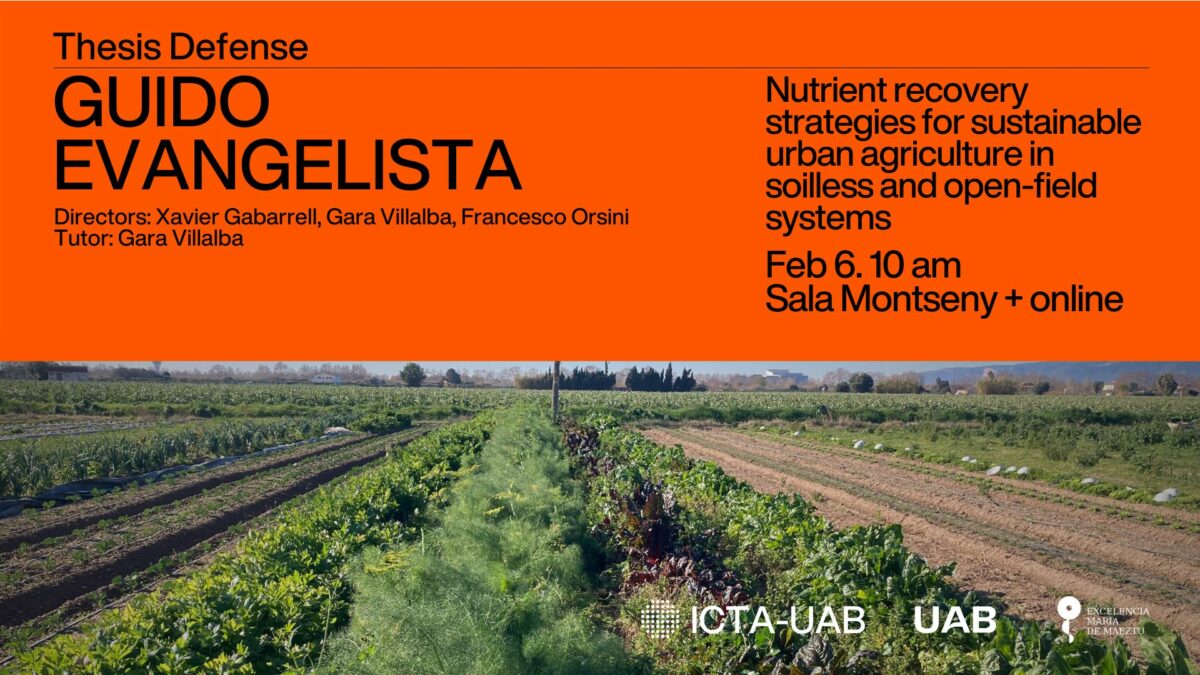
[Cat] És un gran plaer convidar-vos a la presentació de Tesi Doctoral d’en Guido Evangelista el proper 6 de Febrer a les 10:00 a l’ICTA-UAB sala Montseny Z/022- Z/023. També és possible connectar-se online seguint aquest enllaç.
[Eng] It is a great pleasure to invite you to Guido Evangelista’s PhD Thesis defense on February 6th at 10:00 AM at ICTA-UAB (Montseny Room Z/022- Z/023). You can also join online via this link.
Títol de la tesi: Nutrient recovery strategies for sustainable urban agriculture in soilless and open-field systems
Supervisors: Dr. Xavier Gabarrell (UAB), Dr. Gara Villalba (UAB) and Dr. Francesco Orsini (University of Bologna)
Summary:
Global food production faces major pressures including soil degradation, deforestation, rising input costs, and environmental pollution. With the world population projected to reach almost 10 billion by 2050 – while currently hundreds of millions are experiencing hunger – food production must increase to sustain them. Yet expanding agriculture is limited by land scarcity and cannot rely on further increases in greenhouse gas emissions, that are estimated to account for 21 – 37% of the global emissions.
Urban agriculture (UA) offers part of the solution by producing food closer to consumers, reducing transport, storage, and waste. UA takes many forms, from soil-based community gardens to rooftop greenhouses equipped with hydroponic systems. However, these systems still heavily rely on synthetic fertilizer inputs, whose life cycle generates environmental degradation, greenhouse gases, eutrophication, and geopolitical dependence. With a circular economy approach – using recovered nutrients from compost, wastewater treatment plant struvite or municipal pruning waste – can reduce reliance on external fertilizers and related environmental costs. These alternatives, however, must be carefully managed to avoid risks such as nutrient imbalances, reduced yields and quality of the produce, and overall environmental performance. For this reason, experimental trials should be conducted.
This dissertation aims to fill this gap by evaluating the feasibility of recovered nutrients in producing horticultural products in both soilless and soil-based systems. This is done by conducting analysing the outcomes of various experiments conducted in two contrasting UA contexts:
- A hydroponic system in the ICTA-UAB integrated-rooftop greenhouse (i-RTG). In this setting, the outcomes of 11 tomato cycles were analysed, focusing with data of production, inputs consumption and environmental impact measured through Life Cycle Assessment (LCA) tools.
- A soil-based field located in the agrarian park of El Baix Llobregat, where ramial chipped wood (RCW), compost or struvite were applied to grow spinach and sweet potato. Yield, soil state and emissions of CO2, CH4, N2O and NH3 during the crop cycles were assessed.
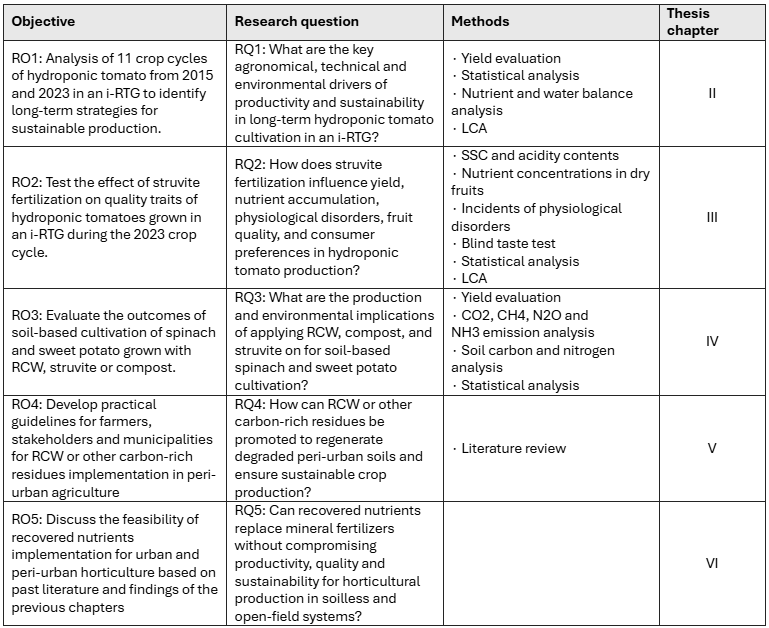
Together, these studies aim to assess the agronomic performance, quality outcomes, and environmental implications of nutrient recovery implementation by answering to the following questions:
RQ1. What are the key agronomical, technical and environmental drivers of productivity and sustainability in long-term hydroponic tomato cultivation in an i-RTG?
RQ2. How does struvite fertilization influence yield, nutrient accumulation, physiological disorders, fruit quality, and consumer preferences in hydroponic tomato production?
RQ3. What are the production and environmental implications of applying RCW, compost, and struvite for soil-based spinach and sweet potato cultivation?
RQ4. How can RCW or other carbon-rich residues be promoted to regenerate degraded peri-urban soils and ensure sustainable crop production?
RQ5. Can recovered nutrients replace mineral fertilizers without compromising productivity, quality and sustainability for horticultural production in soilless and open-field systems?
The development of this research followed a methodological approach that consisted in the experimental setup, data of yield and quality indexes collection, field emissions collection, data analysis and validation of through statistical tests. For every experiment, the results of nutrient recovery implementation were compared to a control treatment employing mineral or other conventional fertilizers. These steps involved the adoption of various tools such as Life Cycle Assessment, analytical tools and panel tests to evaluate tomato fruit quality and static chambers to measure the gaseous emissions of soil-based experiments.
The research questions and objectives are summarized in the following table: