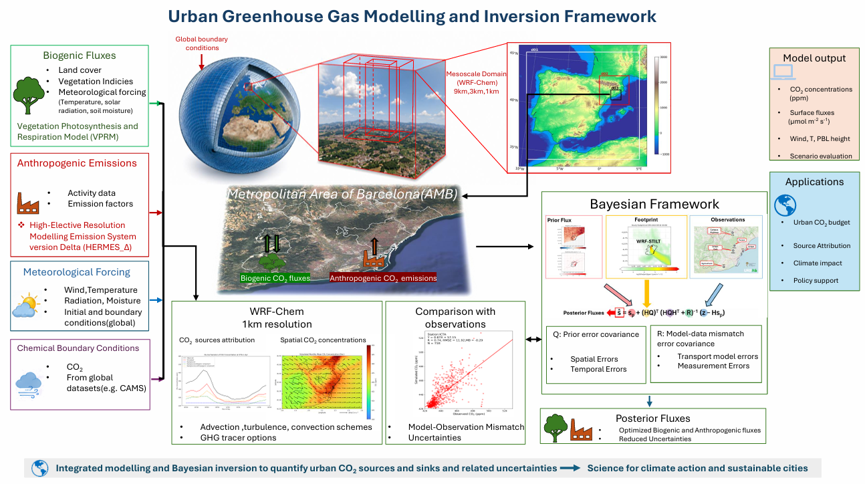
To investigate how cities exchange carbon with the atmosphere, respond to extreme weather and influence air quality, here we develop and apply a suite of atmospheric models to the Metropolitan Area of Barcelona (AMB).
Our modelling framework combines biosphere models, atmospheric transport models and Bayesian inversion techniques, including the Vegetaion Phytosthesis and Respiration model(VPRM), Weather and Research Forecasting model (WRF), WRF coupled with chemical transport (WRF-Chem), Stochastic Time Inverted Lagrangian Transport model (STILT), and Inversion Framework. Together, these tools help us better understand urban climate processes and provide scientific evidence to support sustainable and climate-resilient cities.
Greenhouse Gas(GHG) Modelling
Cities are responsible for the majority of global greenhouse gas emissions and therefore play a central role in climate action. To design effective mitigation strategies, it is essential to understand where GHG come from, where they are removed, and how they move through the urban atmosphere.
We are developing an integrated urban GHG modelling and Bayesian inversion framework to AMB. The framework combines high-resolution biospheric CO2 fluxes, anthropogenic emission inventories, atmospheric transport models, and GHG observations to quantify the urban carbon budget, identify the contributions of biosphere and human activities to atmospheric CO2 , and estimate the uncertainties associated with these calculations.
The framework can be applied to evaluate and improve greenhouse gas inventories, supporting evidence-based climate mitigation policies and urban planning.
Featured research
Heat and Drought Events Alter Biogenic Capacity to Balance CO2 Budget in South-Western Europe
Extreme Weather-Heat waves
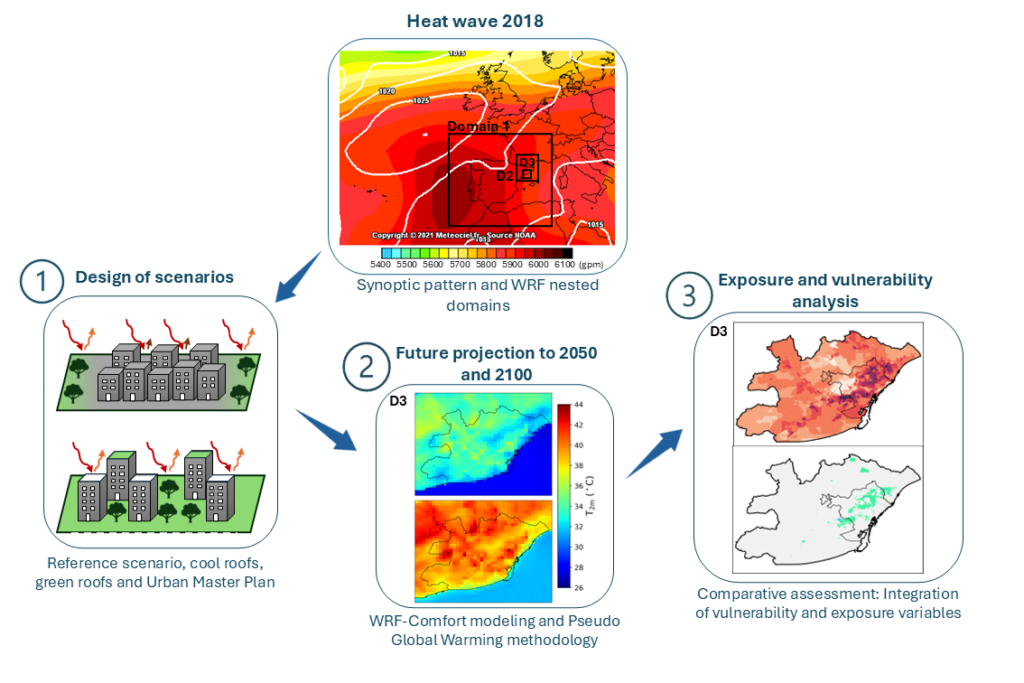
Climate change is expected to increase the frequency, duration, and intensity of extreme weather events, particularly heat waves.
We are interested in how future climate scenarios with more frequent heat waves (HW) will affect cities. This is especially important to determine the efficacy of strategies of increasing urban green and other land use changes to reduce the effect of HW in the long term.
Air quality
Urbanisation changes natural landscapes into buildings, roads, and other impervious surfaces, altering local weather conditions and air quality.
Using WRF-Chem coupled with an urban canopy model, we investigate how changes in land use—such as urban expansion, agriculture, and the development of parks and green spaces—influence urban climate (temperature, wind, and boundary-layer processes) and atmospheric chemistry. We assess their impacts on important air pollutants, including nitrogen dioxide (NO₂), ozone (O₃), volatile organic compounds (VOCs), and particulate matter (PM).
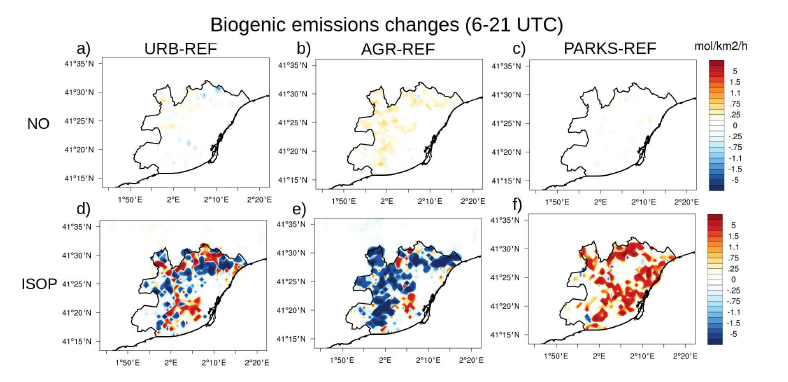
Read more: Badia, A., Segura-Barrero, R., Ventura, S. et al. Effect of land use changes on air quality: impacts of urbanization, urban vegetation, and agriculture. npj Urban Sustain 5, 113 (2025). https://doi.org/10.1038/s42949-025-00303-y
Collaborators