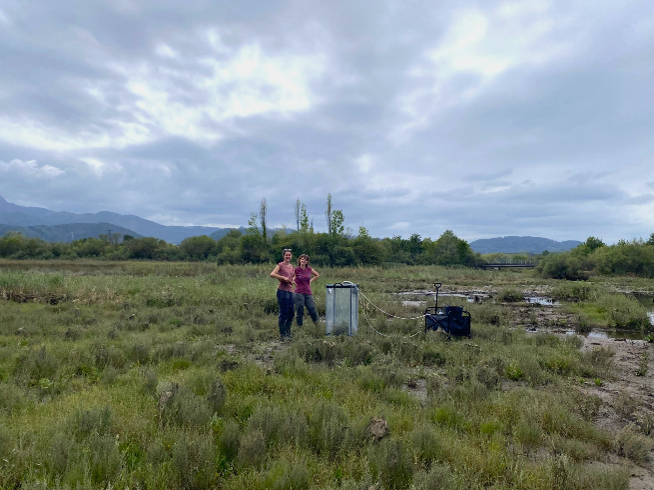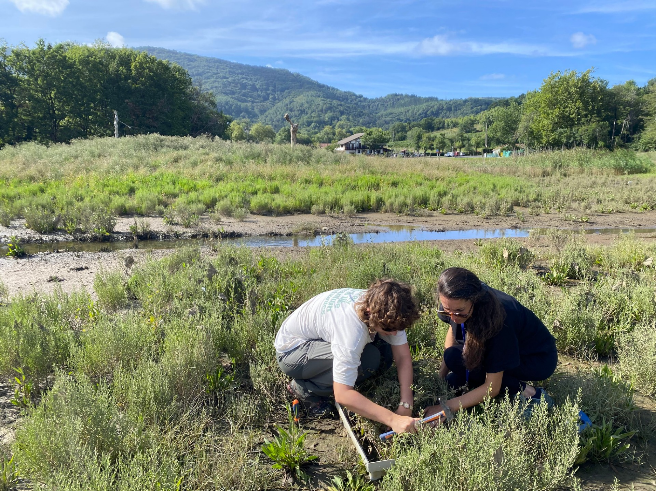
At the beginning of September, Ariane Arias Ortiz and Angèlica Busquets Rubiés, together with researchers from AZTI, visited the Txingudi marshes in the Basque Country. The aim was to measure CO₂ and CH₄ emissions from different areas of the estuary.
To do this, we used static chambers together with a LI-7810 gas analyser. By measuring changes in gas concentrations over time inside a closed chamber, we can estimate diffusive CO₂ and CH₄ fluxes resulting from soil respiration and plant-mediated transport.
We took measurements in different areas of the estuary. These included: a restored area, where artificial structures that once blocked the natural flow of the tides had been removed; a reedbed dominated by Phragmites australis, the type of vegetation expected to grow back in the restored area; and a former agricultural area with Salicornia spp., which could also be restored in the future.
By comparing these areas, one can get a better understanding of how greenhouse gas emissions vary between marsh habitats and how restoration can influence carbon fluxes in coastal wetlands.