URBAG participation at EGU25

URBAG took part in the EGU General Assembly 2025 in Vienna, where researchers presented their latest work on urban air quality, greenhouse gas fluxes, and nature-based solutions for climate adaptation. Three contributions by Qing Luo, Ricard Segura-Barrero and Svetlana Khromova showcased URBAG’s interdisciplinary approach to tackling climate challenges in urban environments.
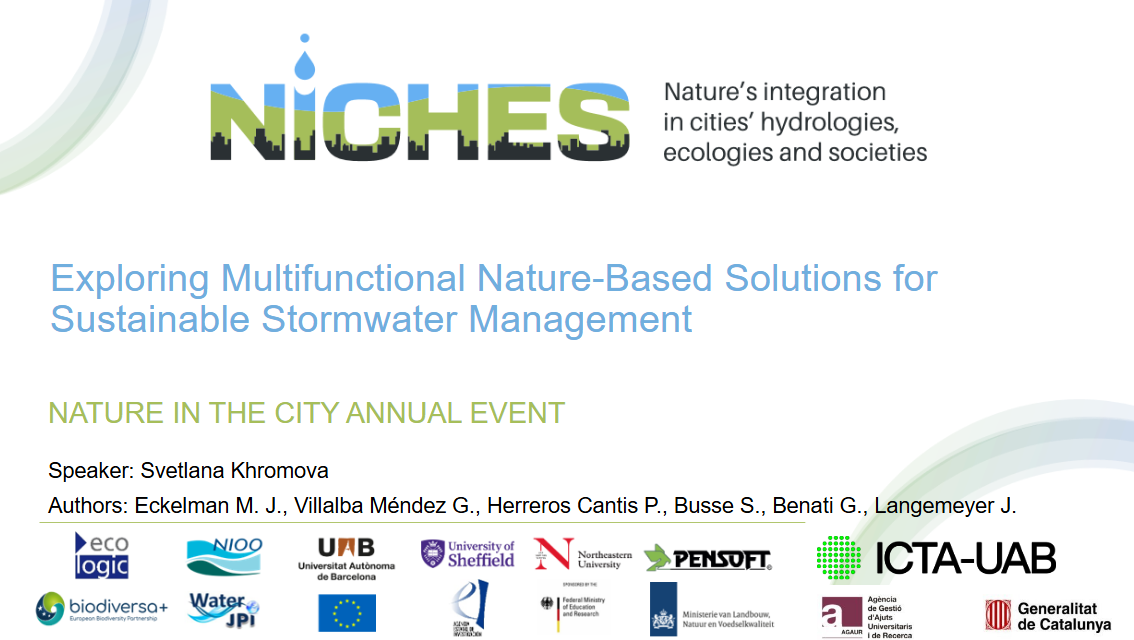
Presentation at the first annual event of the project “Nature in the City”

Exploring Multifunctional Nature-Based Solutions for Sustainable Stormwater Management. Svetlana Khromova presented her work at the first annual event of the project "Nature in the City," focusing on nature-based solutions (NBS) and climate adaptation in urban environments. The event was organized by the Urban School of Science Po in Paris during 11 and 12th of December 2024.

ERC report: Transformative change for a sustainable future

In December, the European Research Council (ERC) published a groundbreaking report addressing this vital question. URBAG joined forces with over 300 ERC-funded projects to shed light on the concept of transformative change and its potential to create a just and sustainable future. The report explores strategies to scale up sustainability while protecting the environment.

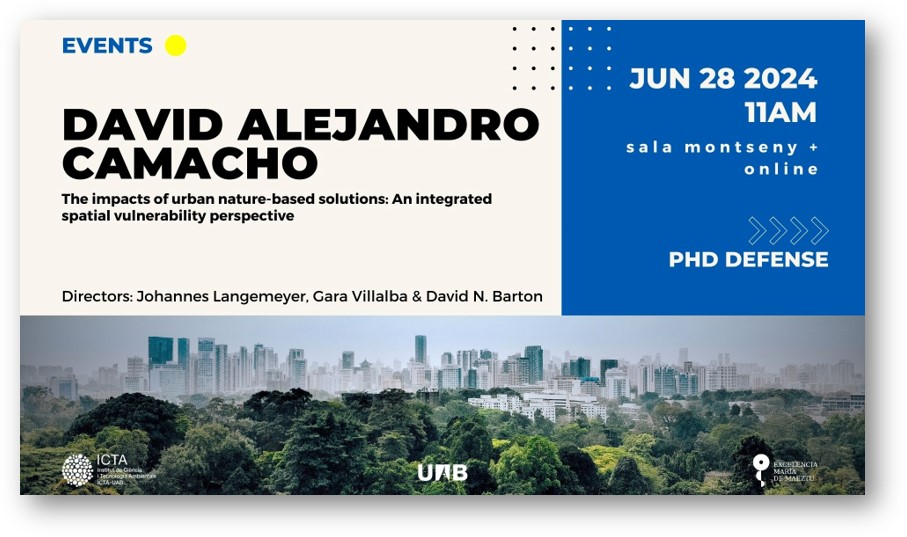
Presentació de tesi Doctoral: The impacts of urban nature-based solutions: An integrated spatial vulnerability perspective

És un gran plaer convidar-vos a la presentació de Tesi Doctoral d’en David Camacho el proper 28 de Juny a les 11:00 a l’ICTA-UAB sala Z/022- Z/023. També és possible connectar-se online mitjançant l'enllaç que proporcionem. Supervisors: Dr. Gara Villalba (UAB), Dr. Johannes Langemeyer (UAB), Dr. David N. Barton (NINA-Oslo)

URBAG presentation at the CONEXUS Conference

Svetlana Khromova presented the first step of an integrated approach to informed Nature Based Solutions (NBS) at the CONEXUS Conference. The CONEXUS conference took place in Barcelona from May 15th  to 17th, which aims to share the knowledge about nature-based urban solutions as a tool for urban planners.

New publication in “Journal of Computational Science”

Title: Modeling air quality at urban scale in the city of Barcelona: A matter of green resolution/ This paper presents the behavior of the most common pollutants and how they are dispersed as a result of different meteorological conditions in the city of Barcelona, as well as the impact of green infrastructures on urban morphology.

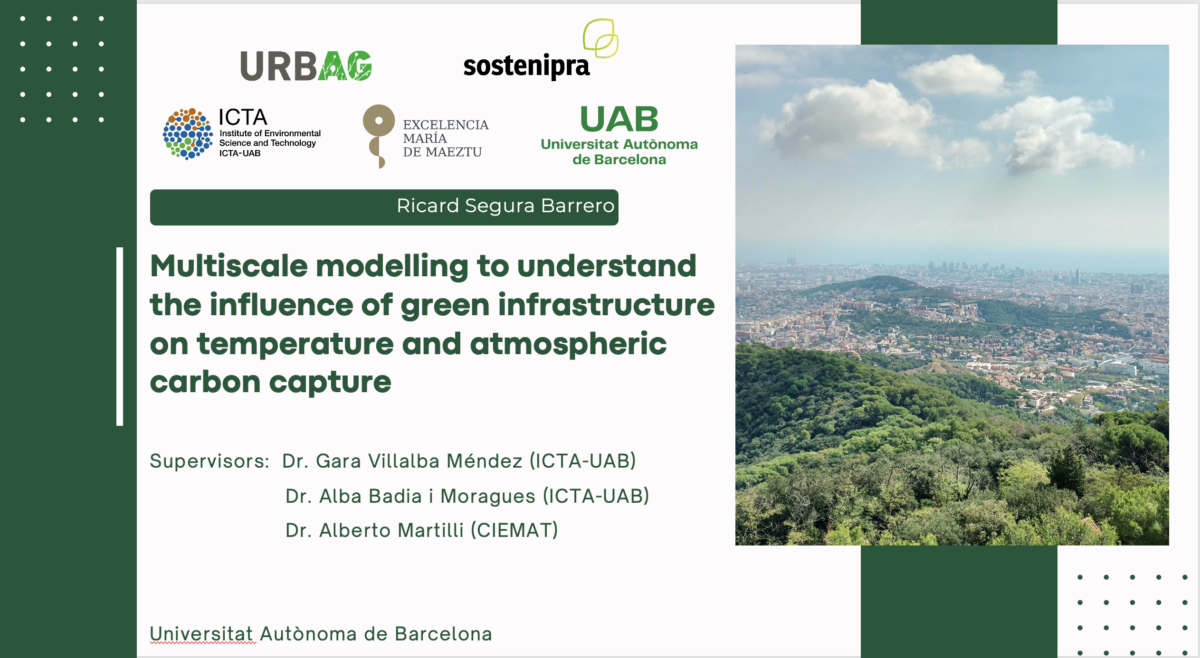
Presentació de tesi Doctoral: Multiscale modelling to understand the influence of green infrastructure on temperature and atmospheric carbon capture

És un gran plaer convidar-vos a la presentació de Tesi Doctoral d’en Ricard Segura el proper 10 de Maig a les 11:00 a l’ICTA-UAB sala Z/022- Z/023. També és possible connectar-se online mitjançant l'enllaç que proporcionem. Supervisors: Dr. Gara Villalba (UAB), Dr. Alba Badia (UAB), Dr. Alberto Martilli (CIEMAT)

Workshop: Green roofs in Oslo by 2030

Green roofs in Oslo by 2030: Stakeholder workshop for co-creating a common understanding of green roofs’ impacts and relevance for the city / An online participatory workshop was conducted involving various stakeholders from the public, academic, and private sectors. URBAG has undertaken the challenge of creating new green spaces within urban environments by evaluating how green roofs can impact local and global vulnerabilities.

New publication in the “International Journal of Applied Earth Observation and Geoinformation”

Title: Assimilating Sentinel-2 data in a modified vegetation photosynthesis and respiration model (VPRM) to improve the simulation of croplands CO2 fluxes in Europe / This paper presents an assimilation of high-resolution Sentinel-2 indices with eddy covariance measurements at selected European cropland flux sites in a new modified version of Vegetation Photosynthesis Respiration Model (VPRM).

New publication in “Sustainable Cities and Society”

Title: Assessing Nature-based solutions in the face of urban vulnerabilities: A multi-criteria decision approach / Nature-based solutions (NBS) are increasingly employed to address urban challenges. Typically, NBS planning emphasizes environmental impacts and ecosystem services, often overlooking their role in addressing vulnerabilities.