The work of the Mataró-born musician Lluís Misón (1727–1766) constitutes a privileged field of study for exploring the relationships between music, body, emotions and identities in the eighteenth century. The tercentenary of his birth, in 2027, offers an opportunity to recover his figure and deepen our understanding of his output from new historiographical perspectives, situating it within the musical and cultural transformations of his time.
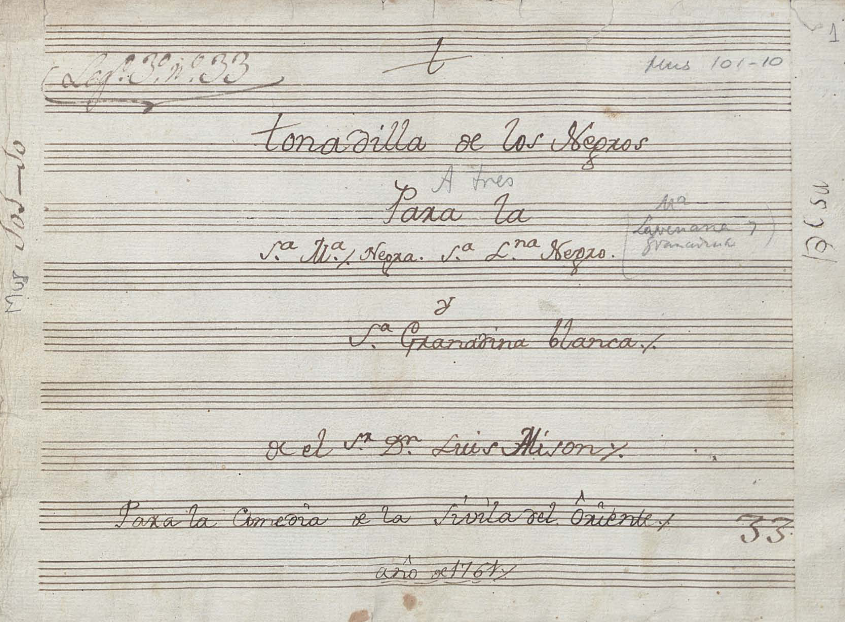
Born in Mataró, the son of a French military officer and a mother connected to the theatrical world, Misón developed much of his professional career in Madrid, where he distinguished himself as a wind instrumentalist and composer. His activity was connected to the Royal Chapel and the Royal Sites, as well as to aristocratic circles such as the House of Alba and the Madrid theatrical world, where he played a significant role in the development of the tonadilla.
His contribution to this genre was recognised by his contemporaries and by subsequent generations. An article published in the Memorial Literario in 1787, entitled «Origen y progresos de las tonadillas que se cantan en los Coliseos de esta Corte», attributed a pioneering role to him, stating that in 1757 he had opened a «nuevo camino a las canciones del Teatro» with a duet composition that became a model for later tonadillas. The previous year, Luis Cañuelo, in the journal El Censor, highlighted some of his tonadillas for possessing «sentimientos y lo que se llama sistema», a particularly suggestive testimony regarding the assessment of his expressiveness and musical coherence.
His instrumental output, particularly his sonatas, also constitutes a significant part of his legacy. Recent discoveries of new sonatas have contributed to a reassessment of his work and to growing interest in his music, which is progressively being incorporated into concert repertoires. This repertoire also opens up new avenues for exploring eighteenth-century performance practices and expressive models, as well as the relationships between instrumental music and the bodily dimension of performance.
Within the framework of the project Music and Experience in the Eighteenth Century, the study of Misón allows us not only to recover the career of a significant composer, but also to investigate how his music was created, performed, perceived and valued, and what it reveals about musical experiences in the past.
Basic bibliography
- Pessarrodona, Aurèlia and Germán Labrador (eds.) (2020). Estudios en torno a Luis Misón. Estudios Musicales del Clasicismo, 5. Sant Cugat del Vallès: Arpegio. A key collective monograph on Misón, with studies on his biography, reception, musical output and the cataloguing of his work.
- Díez-Canedo Flores, María (2007). «La flauta travesera en las dos orillas. Una sonata de flauta de Luis Misón en México». Cuadernos de Música Iberoamericana, 14, 41–72. This study examines a Misón sonata preserved in a Mexican manuscript and provides biographical and contextual information on the circulation of his music.
- Pessarrodona, Aurèlia (critical study and edition) (2008). Manuel Pla, Lluis Misson, Pau Esteve, Jacinto Valledor: La «tonadilla» escènica i Catalunya. Barcelona: Tritó. A useful reference for situating Misón within the context of the tonadilla and its relationship with Catalonia.
- Álvarez-Villamil, María and María Díez-Canedo Flores (critical eds.) (2023). Sonatas y tríos de Luis Misón (1727–1766), para flauta, violín y bajo. Madrid: ICCMU, Música Hispana series. A musical edition providing direct access to part of his instrumental output.