See full article: https://doi.org/10.1016/j.uclim.2026.103086
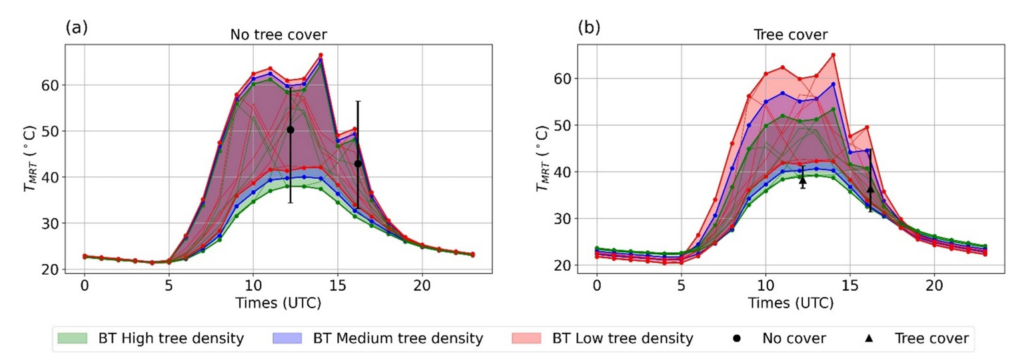
Abstract: Street trees can significantly reduce urban heat through shading and transpirative cooling, but their effectiveness may be compromised during heat waves with dry soil conditions. This study assesses the cooling potential of street trees using a modified BEP-Tree model incorporating soil moisture dynamics and thermos-physiological indices like the Universal Thermal Climate Index (UTCI). The model is first validated with a micrometeorological measurement campaign during hot summer days in a town in the Metropolitan Area of Barcelona, Spain, yielding a good model performance representing the spatial variability of the mean radiant temperature and UTCI inside the studied neighbourhood. Then, BEP-Tree is used to simulate two highly-compact neighbourhoods with differing tree densities in the city of Barcelona, combined with varying soil moisture levels during a heat wave. Results show that street trees in moist soil reduced air temperatures by an average of 1.2 ± 0.4 °C, leading to UTCI reductions up to 3.2 °C. Albeit air-cooling effects were reduced under dry-soil conditions, shade-driven temperature reductions remained substantial, retaining 71–97% of the cooling effect. The findings highlight the importance of tree shading rather than air-cooling in maximising the cooling capabilities of street trees during extreme heat events. Additionally, it is crucial to maintain adequate soil moisture to preserve tree health and substantial foliage to provide consistent microclimatic benefits, particularly during periods of strong heat stress.