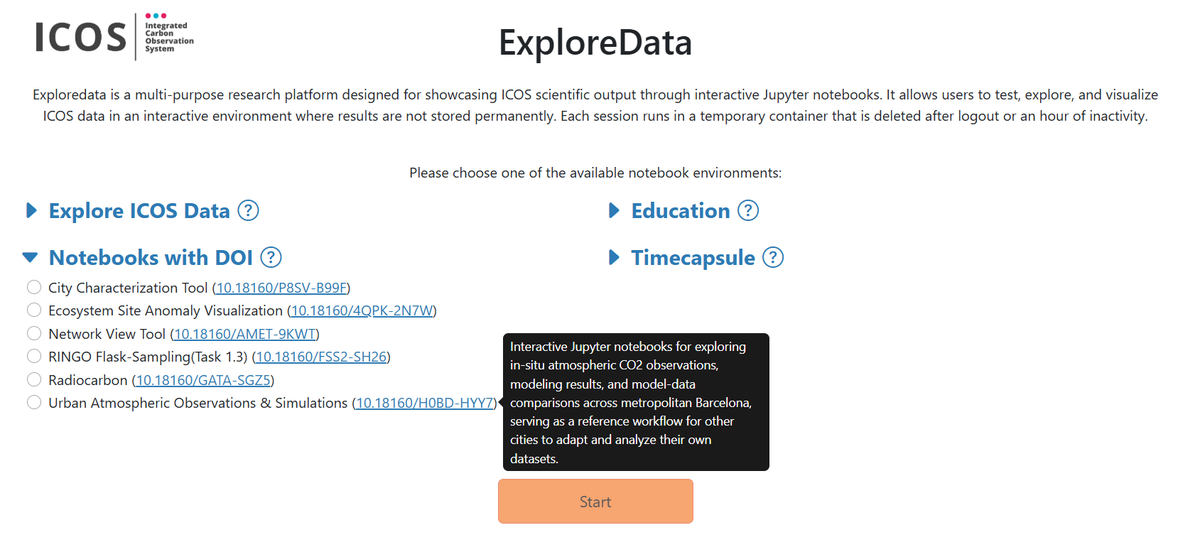
We are happy to announce the release of a new suite of Jupyter Notebooks on the ICOS ERIC Data Portal.
Jupyter Notebooks are open-source, interactive computing tools that combine code, visualisations, and explanatory text into a single document.
Through a close collaboration with the ICOS ERIC Data Portal team, Vanessa Monteiro and Qing Luo developed these open-access tools to support data analysis and model-observation comparisons. Using atmospheric data and transport modelling from metropolitan Barcelona, the package demonstrates how other cities can explore and evaluate their own urban greenhouse gas datasets.
Organised into three distinct notebooks, the package allows users to:
- Explore In-Situ Observations: Retrieve and analyze atmospheric CO2 data directly from the ICOS Cities Data Portal.
- Visualize High-Resolution Models: Work with NetCDF files and navigate urban atmospheric transport modelling.
- Compare Models and Observations: Directly evaluate model performance against real-world in-situ measurements.
Developed under the ICOS Cities (PAUL) framework, these notebooks provide a practical reference workflow and customizable template for researchers, urban planners, and municipalities looking to analyze urban greenhouse gases.
Check out the notebooks on the ICOS Data Portal:
Launch ICOS Jupyter Service with these notebooks and their associated environment below. The project can also be run locally. The requirements.txt file contains a list of all Python packages needed to run the notebooks. Authentication is required via the ICOS Carbon Portal. Read more in https://icos-carbon-portal.github.io/pylib/icoscp/authentication/