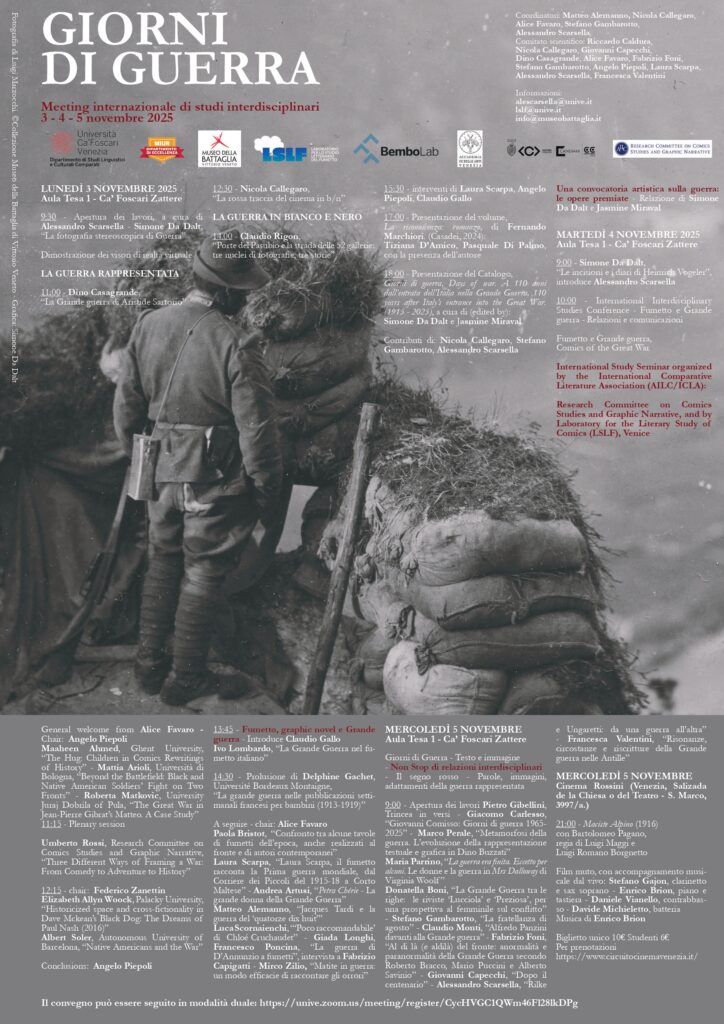
From 3 to 5 November, the international, interdisciplinary conference Giorni di Guerra: La Photo-Graphika del Trauma (Days of War: Photographics of Trauma) was held in Venice. The event was organised by the Museo della Battaglia di Vittorio Veneto and Università Ca’ Foscari Venezia, in collaboration with the ICLA Research Committee on Comics Studies and Graphic Narrative.
The conference explored the representation of war across three main media—photography, literature, and illustration/graphic narrative—from a comparative and transmedial perspective. The project arises from Alessandro Scarsella’s monograph Teoria di un conflitto mondiale (Marietti, 2023), which foregrounds the anthropological dimensions of war representation and the interaction of different languages in personal and collective narratives. It investigates the cognitive models and social behaviours that shape war stories, extending well beyond the immediate context of conflict.
The programme combined two main conferences and an international seminar with teaching exhibitions, readings, and film screenings, all devoted to examining how war is mediated through photography, writing, graphics, and comics.
On November 4, Dr Albert Soler Ruda participated in the conference with the paper “Dog soldiers and storytellers. The Great War and the construction of the indigenous citizen and their inherited narratives of memory through comics.” In this presentation, Soler focused on the representation of the indigenous American warrior in modern images and narratives related to memory, trauma, and the Great War.
Conceived as the ultimate tool for dominating, acculturating and integrating native communities, the recruitment of young indigenous Americans into the Canadian and American armies was considered the definitive step in the colonisation and conquest projects on the North American frontier. Thus, the decision to regularly integrate indigenous youth into a national army was not only intended to adapt them to the Western political and social model, but also to change their psyche through the disruption of trauma and modern warfare.
The deployment of indigenous troops in the trenches of Flanders, however, was publicised as an exotic and propagandistic element, as the last remnant of the wild frontier within the modern world, manipulating the image of Native soldiers as noble warriors, fierce savages, among others. Although Soler notes that part of that narrative is preserved in novels, stories, and especially in comics, he also argues that the indigenous tradition vindicates service and sacrifice through new representations.