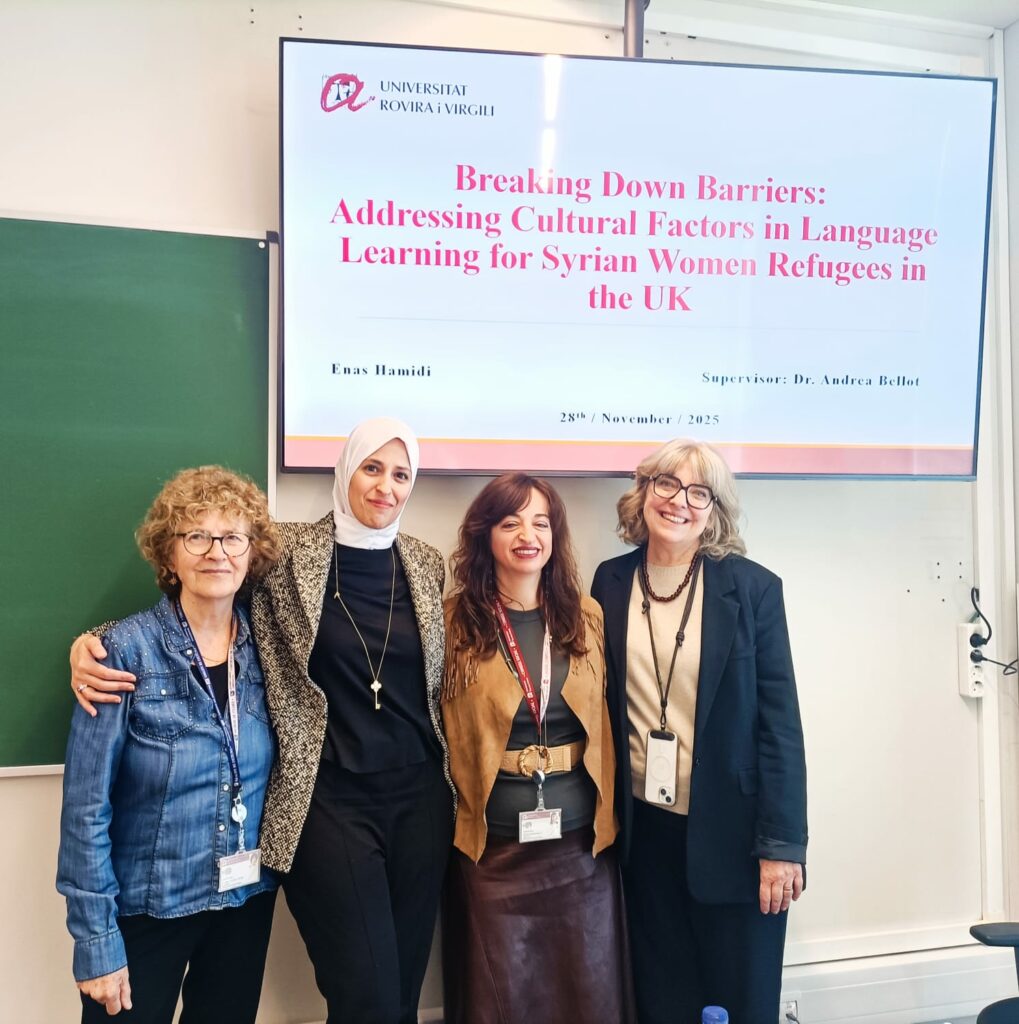
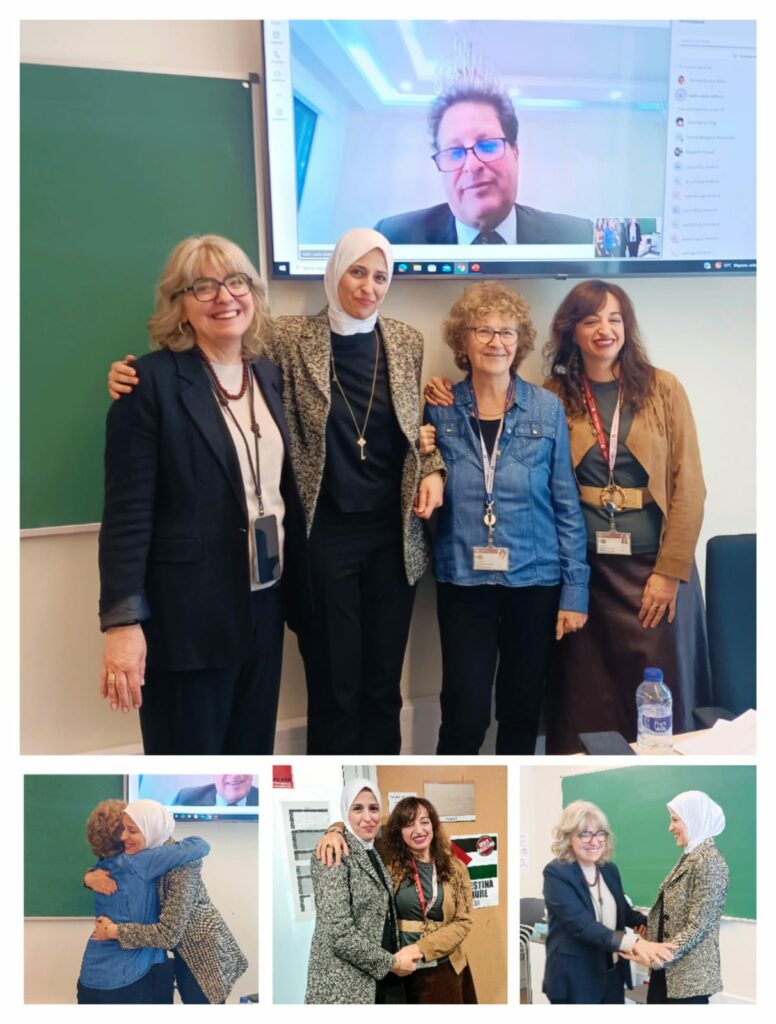
We are happy to announce the successful defence of Enas Talib Farid Hamidi’s doctoral thesis, “Breaking Down Barriers: Addressing Cultural Factors in Language Learning for Syrian Women Refugees in the UK,” presented in the Doctoral Programme in Humanistic Studies at the Universitat Rovira i Virgili (Tarragona).
Although Enas’s project does not sit strictly within literary and cultural studies, it speaks directly to many of the ethical and political concerns that underpin our work on war memory and displacement. Hanadi’s research explores the gendered barriers and cultural constraints faced by Syrian refugee women over 30 as they try to rebuild their lives in the UK, learn English and deal with everyday communication after experiences of forced migration and trauma.
Drawing on quantitative and qualitative data from 115 participants and 19 ESOL teachers, the thesis examines how traditional gender roles, limited access to formal education, social isolation, age-related challenges and the psychological effects of war intersect to shape these women’s language-learning trajectories. At the same time, Hamadi shows how many participants develop creative strategies to engage with English in their daily lives (through mobile phones, social media and informal conversations) turning language into a tool for agency and future possibility.
Hanadi’s focus on the voices and lived experiences of Syrian refugee women reminds us that language learning is never just a technical skill: it is bound up with questions of gender, visibility and belonging.
The thesis was supervised by Dr Bellot, and Dr Cristina Pividori had the pleasure of serving on the examination board.
We warmly congratulate Dr Enas Talib Farid Hamidi on her achievement and thank her for a thesis that builds important bridges between language education and refugee studies.