See full article/ Veure l’article complet
English:
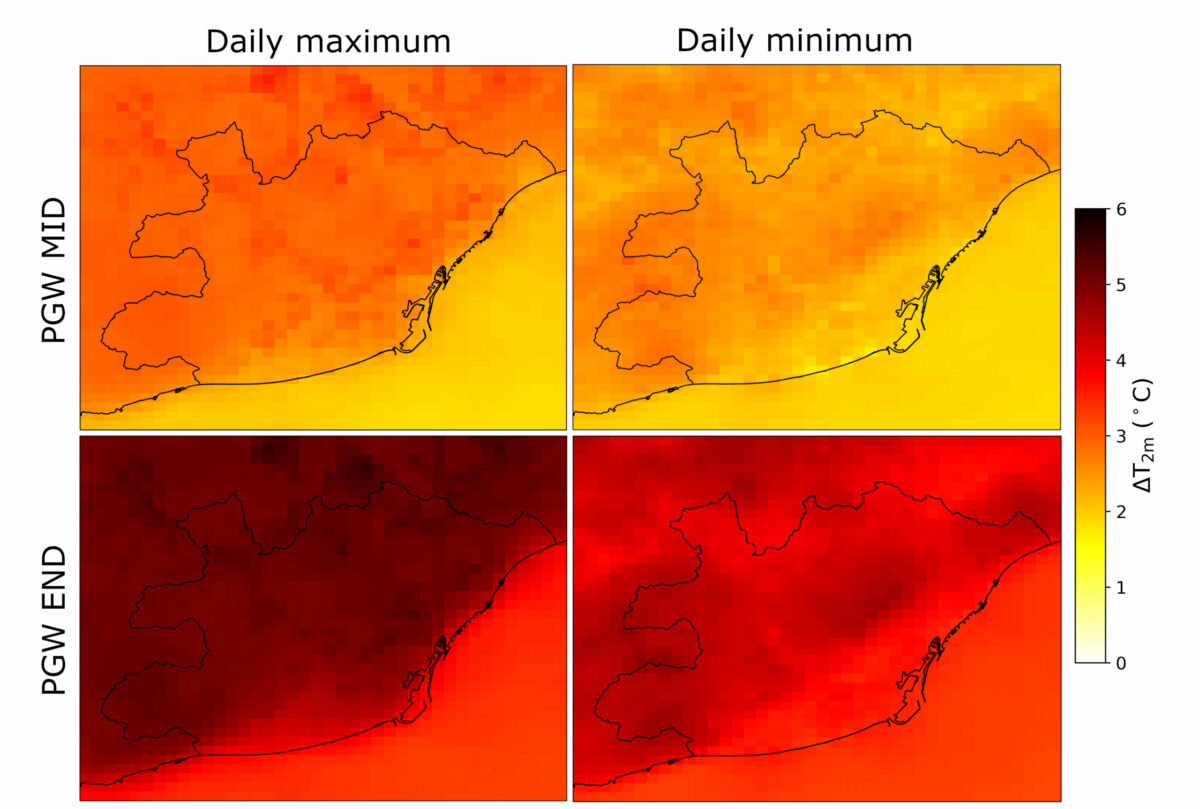
Given that more than half of the world’s population currently resides in cities, further understanding of the potential impact of future climate change on urban areas is needed. In this regard, we project recent heatwave (HW) episodes in the Metropolitan Area of Barcelona (AMB) with future climate conditions until 2100 using the pseudo global warming method. First, we determine all the HWs that occurred in the AMB during the last climatological period of 30 years (1991–2020) and simulate each individual event using the Weather and Research Forecasting (WRF) model at high-resolution. Then, these historical HW events are resimulated with the modified atmospheric conditions of the midcentury (2041–2070) and the end of the century (2071–2100) according to the scenario SSP3-7.0, in which CO2 emissions are projected to almost double from current levels by 2100 following a low emission reduction scenario. In the AMB, HW intensity is expected to increase by 2.5°C and 4.2°C in the mid- and end-of-the-century periods, respectively. Higher temperatures are related to the stationary and stable synoptic pattern, which, among the four analyzed, is projected to experience the greatest intensification in the future. The geopotential height at 500 hPa could increase up to 100 geopotential meters (gpm) by the end of the century, leading to values up to 6,050 gpm, which indicates changes in thermodynamic and dynamic effects resulting in potentially warmer HW episodes. The results obtained can aid in understanding the expected changes for this century, which could facilitate the formulation of heat mitigation and adaptation strategies, particularly for the most exposed areas.
Català:
Atès que més de la meitat de la població mundial resideix actualment en ciutats, cal aprofundir en la comprensió del possible impacte del canvi climàtic futur en les zones urbanes. En aquest sentit, projectem episodis recents d’ones de calor (OC) a l’Àrea Metropolitana de Barcelona (AMB) sota condicions climàtiques futures fins a l’any 2100 utilitzant el mètode pseudo global warming. Primer, identifiquem totes les OC que han tingut lloc a l’AMB durant l’últim període climatològic de 30 anys (1991–2020) i simulem cada episodi de forma individual mitjançant el model Weather and Research Forecasting (WRF) a alta resolució. A continuació, aquests episodis històrics d’OC es tornen a simular amb condicions atmosfèriques modificades per als períodes de mitjan segle (2041–2070) i de finals de segle (2071–2100), segons l’escenari SSP3-7.0, en el qual es preveu que les emissions de CO₂ gairebé es duplicaran respecte als nivells actuals l’any 2100, seguint un escenari amb baixa reducció d’emissions. A l’AMB, s’espera que la intensitat de les OC augmenti en 2,5 °C a mitjan segle i en 4,2 °C a finals de segle. Aquest augment de les temperatures està relacionat amb un patró sinòptic estacionari i estable, que, entre els quatre analitzats, es preveu que experimenti la major intensificació en el futur. L’alçada geopotencial a 500 hPa podria incrementar-se fins a 100 metres geopotencials (gpm) a finals de segle, arribant a valors de fins a 6.050 gpm, cosa que indica canvis en els efectes termodinàmics i dinàmics que podrien donar lloc a episodis d’OC potencialment més càlids. Els resultats obtinguts poden contribuir a comprendre millor els canvis esperats durant aquest segle, fet que podria facilitar la formulació d’estratègies de mitigació i adaptació a la calor, especialment en les zones més exposades.
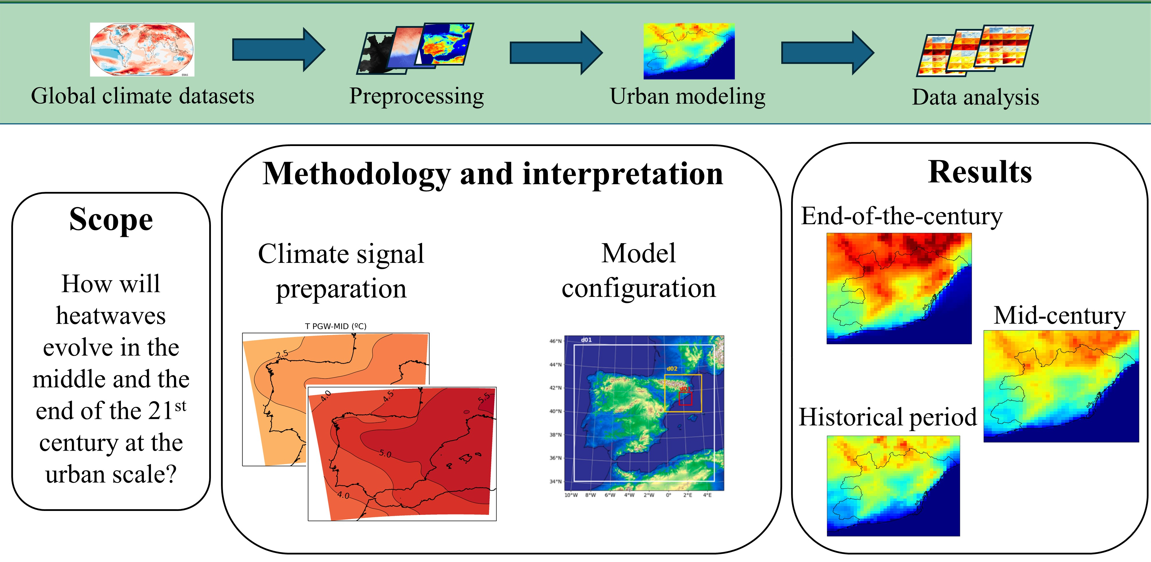
Figure: Graphical abstract of the study/ Representació gràfica de l’estudi