A new paper has been posted as a preprint on the Research Square platform.
See full article/ Veure l’article complet
English:
Street trees can significantly reduce urban heat through shading and transpirative cooling, but their effectiveness may be compromised during heat waves with dry soil conditions. This study assesses the cooling potential of street trees using a modified BEP-Tree model incorporating soil moisture dynamics and thermos-physiological indices like the Universal Thermal Climate Index (UTCI). The model is first validated with a micrometeorological measurement campaign during hot summer days in a town in the Metropolitan Area of Barcelona, Spain, yielding a good model performance representing the spatial variability of the mean radiant temperature and UTCI inside the studied neighbourhood. Then, BEP-Tree is used to simulate two highly-compact neighbourhoods with differing tree densities in the city of Barcelona, combined with varying soil moisture levels during a heat wave. Results show that street trees in moist soil reduced air temperatures by an average of 1.2±0.4°C, leading to UTCI reductions up to 3.2°C. Albeit air-cooling effects were reduced under dry-soil conditions, shade-driven temperature reductions remained substantial, retaining 71-97% of the cooling effect. The findings highlight the importance of tree shading rather than air-cooling in maximising the cooling capabilities of street trees during extreme heat events. Additionally, it is crucial to maintain adequate soil moisture to preserve tree health and substantial foliage to provide consistent microclimatic benefits, particularly during periods of strong heat stress.
Català:
Els arbres de carrer poden reduir significativament la calor urbana mitjançant l’ombra i el refredament transpiratiu, però la seva eficàcia pot veure’s compromesa durant les onades de calor amb condicions de sòl sec. Aquest estudi avalua el potencial de refredament dels arbres de carrer utilitzant una versió modificada del model BEP-Tree que incorpora la dinàmica de la humitat del sòl i índexs termo-fisiològics com l’Universal Thermal Climate Index (UTCI). El model es valida primerament amb una campanya de mesuraments micrometeorològics durant dies càlids d’estiu en un municipi de l’Àrea Metropolitana de Barcelona, obtenint un bon rendiment en la representació de la variabilitat espacial de la temperatura radiant mitjana i de l’UTCI dins el barri estudiat. A continuació, el model BEP-Tree s’utilitza per simular dos barris d’alta compacitat amb densitats d’arbrat diferents a la ciutat de Barcelona, combinats amb diversos nivells d’humitat del sòl durant una onada de calor. Els resultats mostren que els arbres de carrer en sòls humits redueixen la temperatura de l’aire en una mitjana d’1,2 ± 0,4 °C, comportant reduccions de l’UTCI de fins a 3,2 °C. Tot i que els efectes de refredament de l’aire disminueixen sota condicions de sòl sec, les reduccions de temperatura degudes a l’ombra continuen sent substancials, mantenint entre un 71 i un 97 % de l’efecte de refredament. Les troballes destaquen la importància de l’ombra dels arbres més que no pas del refredament de l’aire per maximitzar la seva capacitat de mitigació tèrmica durant episodis extrems de calor. A més, és fonamental mantenir una humitat del sòl adequada per preservar la salut dels arbres i garantir un fullatge abundant que proporcioni beneficis microclimàtics consistents, especialment durant períodes d’intens estrès tèrmic.
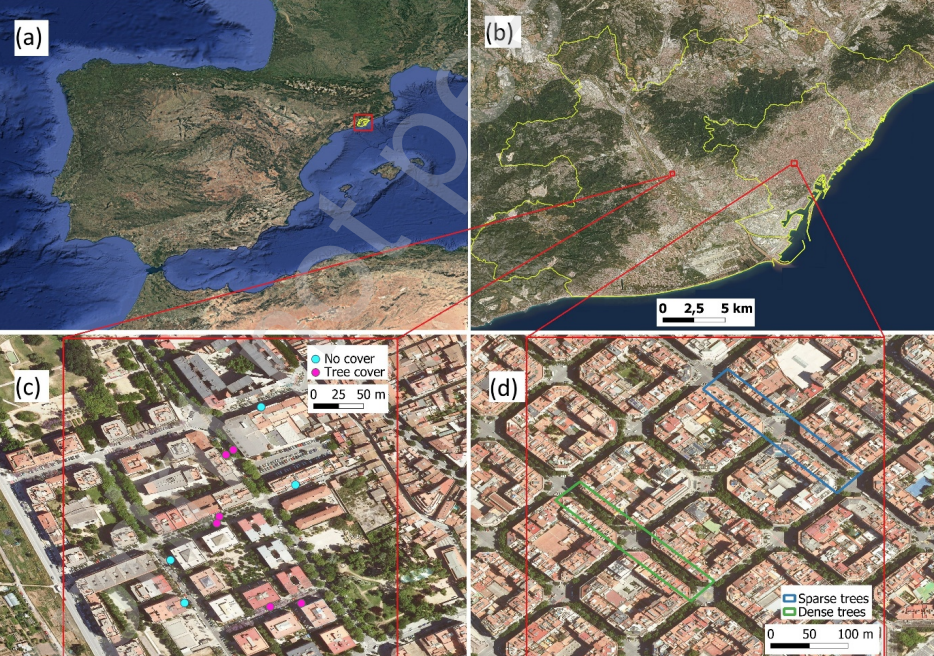
Figure: Location of the Metropolitan Area of Barcelona in the Iberian Peninsula; (b) Administrative boundaries of the Metropolitan Area of Barcelona and the city of Barcelona (yellow), and the location of the Eixample District and the measurement campaign neighbourhoods; (c) measurement campaign neighbourhood in Sant Feliu del Llobregat and sampling locations classified by the presence of tree cover; (d) case study neighbourhood in the Eixample District and the location of Sparse and Dense trees streets.