 | Our Group integrates a series of lines of research, interrelated and developed in the context of High Performance Computing (HPC) |
Research Lines
Considering HPC for Apps & Simulation, the main research lines focuses on two broad areas:
- HPC Technology
- Applications with Societal Impact
Detailed subjects:
Our project aims to provide solutions to the following problems, while it creates the corresponding technology that allows these solutions to be transferred:
- Performance and Efficiency in the use of HPC resources
- Effect of the interconnection network on the performance of applications
- Performance prediction. Scalability.
- Efficient execution of applications: programming model, energy consumption, heterogeneous multicore.
- Availability of HPC resources (available to user)
- Fault tolerance for HPC in numerical (technical-scientific) and transactional applications.
- Integrity against attacks in use and/or access to the HPC resources (Vulnerability)
- Design and optimization of HPC systems, for “workloads” specific (application-specific domains)
- CPU, network interconnection, I/O & Availability
- Support tools (simulation)
- Social projection (impact) applications (solutions to problems of social impact -smart applications-, which require the capacity of HPC systems):
- Simulation and optimization of Emergency Services in Hospitals (Smarter Health Services)
- Simulation of Individuals oriented Models
- HPCNelogo: Environment for the concurrent execution of ABM models under Netlogo-Behavior Space in an unattended/remote way on an HPC cluster using SGE (Github).
- Simulation and optimization of movements of individuals in constrained environments (Smart Evacuations): Emergency Evacuations.
News
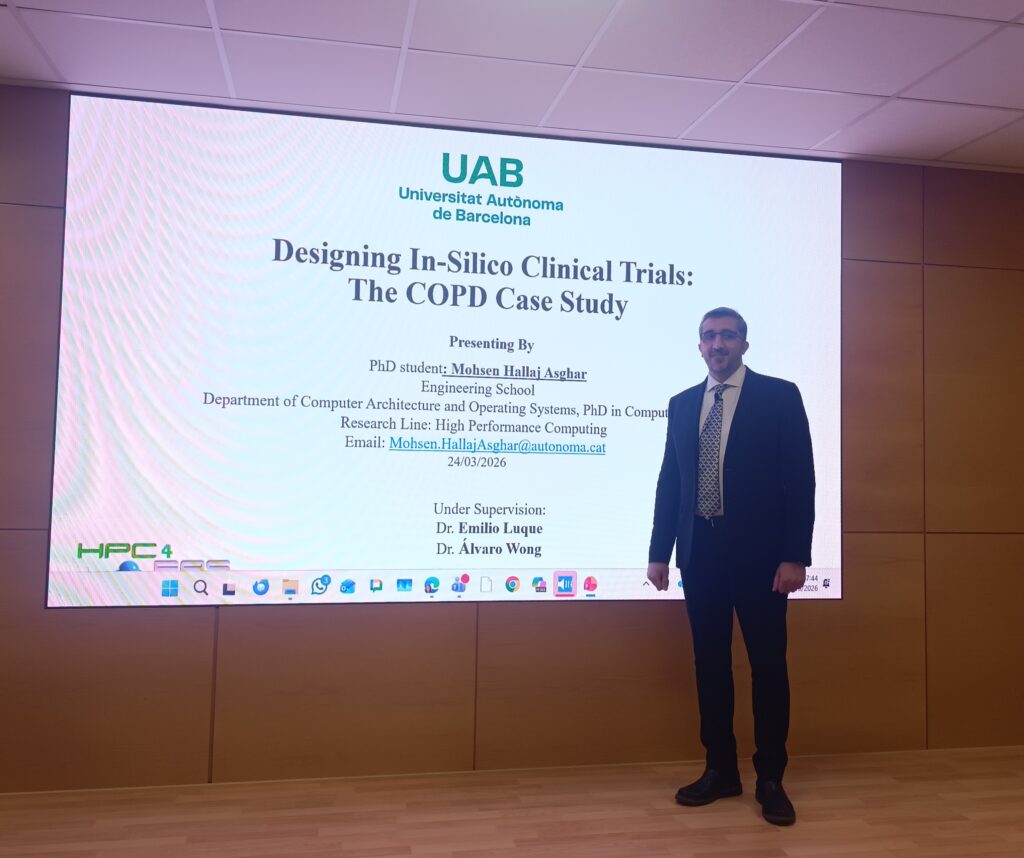
New PhD thesis successfully defended in the field of clinical simulation and computing
We are pleased to announce the successful defense of the PhD thesis entitled:
“Designing In Silico Clinical Trials: The COPD Case Study”, carried out by Mohsen Hallaj Asghar on Tuesday, March 24.
The thesis was supervised by Dr. Emilio Luque and Dr. Álvaro Wong, and focuses on the design of in silico clinical trials, using computational models to study Chronic Obstructive Pulmonary Disease (COPD).
On behalf of the research group, we warmly congratulate Mohsen Hallaj Asghar on this important academic achievement and wish him every success in his future research career.
PhD Thesis Defense: Diego Encinas on I/O Modeling in Parallel Systems
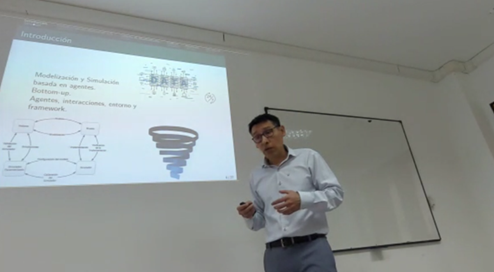
On March 20, Diego Encinas successfully defended his doctoral thesis titled:
“Agent-Based Modeling and Simulation Applied to Input/Output Architecture in Parallel Computers”
The thesis was developed through a collaborative framework between the National University of La Plata (UNLP) and the Universitat Autònoma de Barcelona (UAB), under the supervision of:
Dr. Marcelo Naiouf and Esp. Armando De Giusti (UNLP)
Dr. Emilio Luque and Dr. Dolores Rexachs (UAB)
During the defense, the primary findings of the research were presented, highlighting the potential of agent-based simulation as a powerful tool for analyzing and optimizing I/O systems within High-Performance Computing (HPC) environments.
Our research group extends its warmest congratulations to Diego Encinas on this significant academic milestone and for his valuable contribution to the field of parallel and high-performance systems.
News Blog
-
JCC2024
2024-11-03 08:42 -
ICCS 2024
2024-07-28 08:02 -
PDPTA 2024
2024-07-25 06:28