
Associate Professor


Ricard Gelabert Peiri graduated in Chemical Sciences in 1992 and obtained a Doctorate in Chemistry in 1999 from the Universitat Autònoma de Barcelona. He completed his postdoctoral phase with the group of Dr. William H. Miller at the Pitzer Center for Theoretical Chemistry, at the University of California at Berkeley (USA) between 1999 and 2002. During this period, he contributed to the development of the quantum and semiclassical theory of chemical dynamics.
After being a Ramón y Cajal researcher from 2003 to 2005 and was appointed Associate Professor in the Chemistry Department of the Universitat Autònoma de Barcelona in 2006. With more than 58 published scientific articles and supervising 3 doctoral theses, he has played a prominent role in advancing the understanding of quantum effects in chemical systems, especially in the nature and properties of transition metal complexes with elongated dihydrogens.
In his postdoctoral work, he contributed to the development of the semiclassical theory of chemical dynamics and focused on reactivity in electronically excited states. He has pioneered the study of fluorescent proteins and light-activated molecular switches, with a particular focus on the application of these processes in living tissue.
His recent research has focused on molecular photoswitches based on azobenzene, investigating their application possibilities in photoactive therapies and in the control of biological responses through light. Through his work, he has collaborated with prominent researchers and institutions internationally, expanding knowledge in key areas of theoretical and applied chemistry.
Latest publications
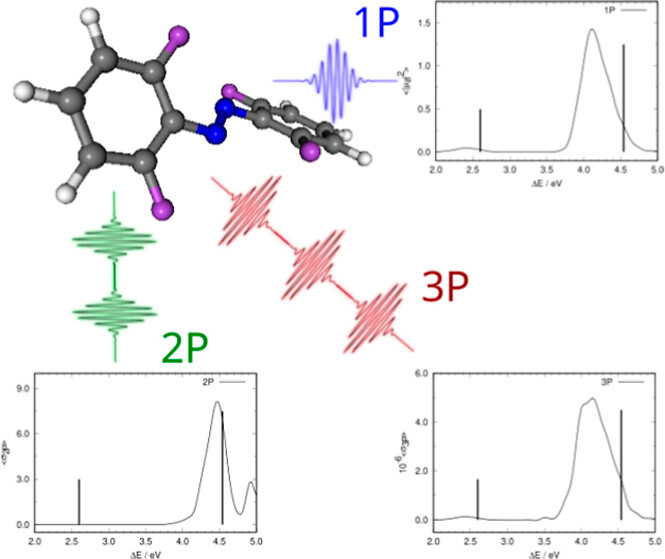

ACS Omega 2024, 9, 41968-41977
Effect of Leaving Centrosymmetric Character on Spectral Properties in Mono-, Bi-, and Triphotonic Absorption Spectroscopies
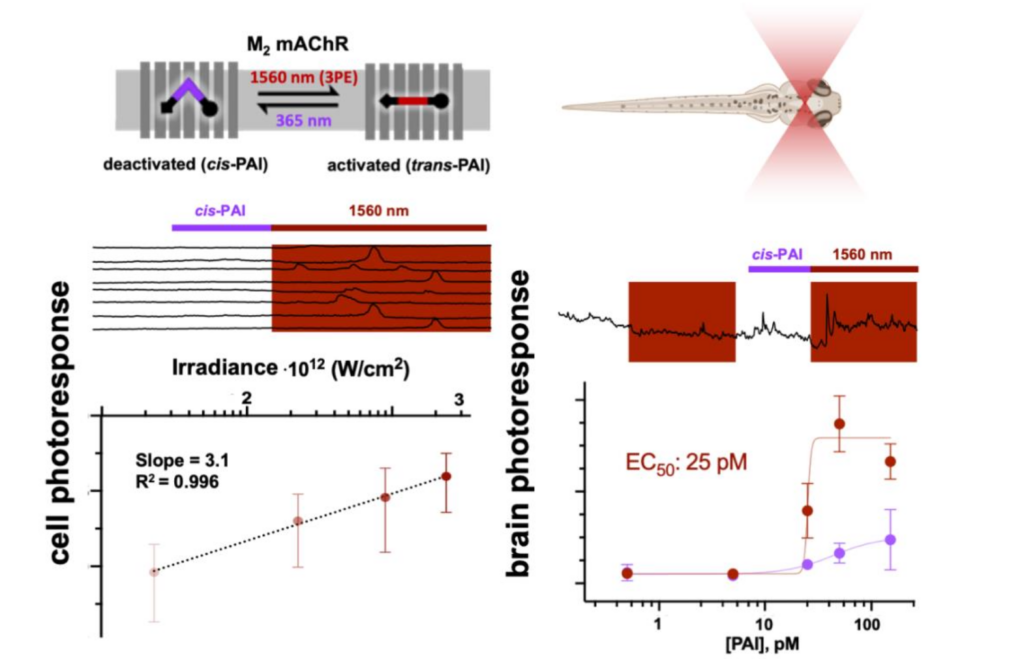

Angewandte Chemie 2023, 135, e202311181
Three‐Photon Infrared Stimulation of Endogenous Neuroreceptors in Vivo
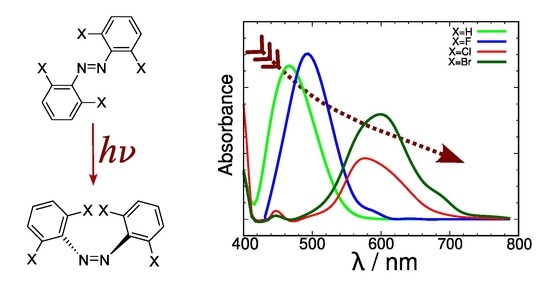

IJMS 2022, 24, 25
Predicting the Electronic Absorption Band Shape of Azobenzene Photoswitches
All publications 60 articles
See all the group’s publications →
2024
Effect of Leaving Centrosymmetric Character on Spectral Properties in Mono-, Bi-, and Triphotonic Absorption Spectroscopies — ACS Omega 2024, 9, 41968-41977
2023
Three-Photon Infrared Stimulation of Endogenous Neuroreceptors in Vivo — Angew. Chem. Int. Ed. 2023, 62, e202311181
Three‐Photon Infrared Stimulation of Endogenous Neuroreceptors in Vivo — Angewandte Chemie 2023, 135, e202311181
2022
Predicting the Electronic Absorption Band Shape of Azobenzene Photoswitches — IJMS 2022, 24, 25
On the Computational Design of Azobenzene-Based Multi-State Photoswitches — IJMS 2022, 23, 8690
2019
Rationally designed azobenzene photoswitches for efficient two-photon neuronal excitation — Nat Commun 2019, 10, 907
Deciphering the grounds of the suitability of acylhydrazones as efficient photoswitches — Phys. Chem. Chem. Phys. 2019, 21, 16075-16082
A high-throughput computational approach to UV-Vis spectra in protein mutants — Phys. Chem. Chem. Phys. 2019, 21, 20678-20692
2018
Ultrafast action chemistry in slow motion: atomistic description of the excitation and fluorescence processes in an archetypal fluorescent protein — Phys. Chem. Chem. Phys. 2018, 20, 11067-11080
2016
Chromophore interactions leading to different absorption spectra in mNeptune1 and mCardinal red fluorescent proteins — Phys. Chem. Chem. Phys. 2016, 18, 16964-16976
The Quest for Photoswitches Activated by Near-Infrared Light: A Theoretical Study of the Photochemistry of BF2-Coordinated Azo Derivatives — ChemPhysChem 2016, 17, 2824-2838
2015
Molecular modelling of the pH influence in the geometry and the absorbance spectrum of near-infrared TagRFP675 fluorescent protein — Phys. Chem. Chem. Phys. 2015, 17, 29363-29373
Theoretical Computer-Aided Mutagenic Study on the Triple Green Fluorescent Protein Mutant S65T/H148D/Y145F — ChemPhysChem 2015, 16, 2134-2139
Transient low-barrier hydrogen bond in the photoactive state of green fluorescent protein — Phys. Chem. Chem. Phys. 2015, 17, 30876-30888
Unveiling How an Archetypal Fluorescent Protein Operates: Theoretical Perspective on the Ultrafast Excited State Dynamics of GFP Variant 565T/H148D — J. Phys. Chem. B 2015, 119, 2274-2291
2014
Are There Really Low-Barrier Hydrogen Bonds in Proteins? The Case of Photoactive Yellow Protein — J. Am. Chem. Soc. 2014, 136, 3542-3552
New insights into the structure-spectrum relationship in S65T/H148D and E222Q/H148D green fluorescent protein mutants: a theoretical assessment — Org. Biomol. Chem. 2014, 12, 9845-9852
2013
A theoretical study of the photochemistry of indigo in its neutral and dianionic (leucoindigo) forms — Phys. Chem. Chem. Phys. 2013, 15, 20236
A time-dependent DFT/molecular dynamics study of the proton-wire responsible for the red fluorescence in the LSSmKate2 protein — Theor Chem Acc 2013, 132, 1327
How Does the Environment Affect the Absorption Spectrum of the Fluorescent Protein mKeima? — J. Chem. Theory Comput. 2013, 9, 1731-1742
2012
Peek at the Potential Energy Surfaces of the LSSmKate1 and LSSmKate2 Proteins — J. Phys. Chem. B 2012, 116, 14302-14310
2011
A method to compute probability current in generic coordinates — The Journal of Chemical Physics 2011, 134, 074115
A variational transition state theory description of periselectivity effects on cycloadditions of ketenes with cyclopentadiene — Theor Chem Acc 2011, 128, 569-577
Photo-deactivation pathways of a double H-bonded photochromic Schiff base investigated by combined theoretical calculations and experimental time-resolved studies — Phys. Chem. Chem. Phys. 2011, 13, 14960
2010
Bipyridyl Derivatives as Photomemory Devices: A Comparative Electronic-Structure Study — Chemistry A European J 2010, 16, 6693-6703
Modulating the Photochemistry of Bipyridylic Compounds by Symmetric Substitutions — ChemPhysChem 2010, 11, 3696-3703
2009
A Theoretical Assessment of Factors Causing Different Molecular Volumes in Isotopologues — J. Phys. Chem. A 2009, 113, 14161-14169
2008
A potential energy function for heterogeneous proton-wires. Ground end photoactive states of the proton-wire in the green fluorescent protein — J. Chem. Theory Comput. 2008, 4, 1138-1150
Electronic-structure and quantum dynamical study of the photochromism of the aromatic Schiff base salicylideneaniline — The Journal of Chemical Physics 2008, 129, 214308
Exploring the Effects of Intramolecular Vibrational Energy Redistribution on the Operation of the Proton Wire in Green Fluorescent Protein — J. Phys. Chem. B 2008, 112, 13443-13452
Operation of the proton wire in green fluorescent protein. A quantum dynamics simulation — J. Phys. Chem. B 2008, 112, 5500-5511
Study of the photochemical properties and conical intersections of [2,2′-bipyridyl]-3-amine-3′-ol — ChemPhysChem 2008, 9, 2068-2076
2007
A comparative study on the photochemistry of two bipyridyl derivatives: [2,2 ‘-bipyridyl]-3,3 ‘-diamine and [2,2 ‘-bipyridyl]-3,3 ‘-diol — ChemPhysChem 2007, 8, 1199-1206
Electronic and quantum dynamical insight into the ultrafast proton transfer of 1-hydroxy-2-acetonaphthone — The Journal of Chemical Physics 2007, 127, 084318
2006
Charge-transfer pi pi* excited state in the 7-azaindole dimer. A hybrid configuration interactions singles/time-dependent density functional theory description — J. Phys. Chem. A 2006, 110, 1145-1151
Potential energy landscape of the photoinduced multiple proton-transfer process in the green fluorescent protein: Classical molecular dynamics and multiconfigurational electronic structure calculations — J. Am. Chem. Soc. 2006, 128, 3564-3574
Theoretical study on the excited-state intramolecular proton transfer in the aromatic Schiff base salicylidene methylamine: an electronic structure and quantum dynamical approach — J. Phys. Chem. A 2006, 110, 4649-4656
2005
Determination of the temperature dependence of the H-D spin-spin coupling constant and the isotope effect on the proton chemical shift for the compressed dihydride complex [Cp*Ir(P-P)H-2](2+) — J. Am. Chem. Soc. 2005, 127, 5632-5640
Elongated dihydrogen versus compressed dihydride complexes: The temperature dependence of the H-D spin-spin coupling constant as a criterion to distinguish between them — Chemistry A European J 2005, 11, 6315-6325
2004
Photoinduced proton transfer from the green fluorescent protein chromophore to a water molecule: analysis of the transfer coordinate — Chemical Physics Letters 2004, 396, 202-207
Quantum dynamics study of the excited-state double-proton transfer in 2,2 ‘-bipyridyl-3,3 ‘-diol — ChemPhysChem 2004, 5, 1372-1378
Synthesis and properties of compressed dihydride complexes of iridium: Theoretical and spectroscopic investigations — J. Am. Chem. Soc. 2004, 126, 8813-8822
2003
Fast hydrogen elimination from the [Ru(PH3)(3)(CO)(H)(2)] complex in the first singlet excited states. A quantum dynamics study — Chemical Physics 2003, 286, 149-163
2002
Semiclassical initial value representation description of molecular structure problems: An elongated dihydrogen ruthenium complex — The Journal of Chemical Physics 2002, 117, 7094-7101
2001
Semiclassical description of diffraction and its quenching by the forward-backward version of the initial value representation — The Journal of Chemical Physics 2001, 114, 2572-2579
Semiclassical description of quantum coherence effects and their quenching: A forward-backward initial value representation study — The Journal of Chemical Physics 2001, 114, 2562-2571
2000
Nuclear dynamics discrete variable representation study of the equilibrium isotope effect on H-2 binding in M(eta(2)-H-2)L-n complexes: An effective theoretical way to account for anharmonicity — J. Phys. Chem. A 2000, 104, 7898-7905
Structure and dynamics of [Nb(eta(C5H4SiMe3)-C-5)(2)(eta(2)-H2BR2)] (R-2 = O2C6H4, C8H14, H-2) complexes. A combined experimental and theoretical study — Organometallics 2000, 19, 3654-3663
A log-derivative formulation of the prefactor for the semiclassical Herman-Kluk propagator — J. Phys. Chem. A 2000, 104, 10321-10327
1999
A DVR analysis of some vibrational modes in the elongated dihydrogen complex [Ru(eta(2)-H-2)(C5H5)(H2PCH2PH2)](+) — Chemical Physics 1999, 241, 155-166
1998
Effect of the spinning motion of the dihydrogen ligand on the properties of an elongated dihydrogen complex. A theoretical study of the trans-[Os(H center dot center dot center dot H)C1(H2PCH2CH2PH2)(2)](+) complex — J. Am. Chem. Soc. 1998, 120, 8168-8176
On the unexpected isotope effect on the exchange coupling constant in partially deuterated transition-metal trihydride complexes — Ber Bunsenges Phys Chem 1998, 102, 354-358
Temperature dependence of proton NMR chemical shift as a criterion to identify low-barrier hydrogen bonds — J. Am. Chem. Soc. 1998, 120, 10203-10209
1997
Elongated dihydrogen complexes: A combined electronic DFT plus nuclear dynamics study of the [Ru(H center dot center dot center dot H)(C5H5)(H2PCH2PH2)](+) complex — J. Am. Chem. Soc. 1997, 119, 9840-9847
Is an extremely low-field proton signal in the NMR spectrum conclusive evidence for a low-barrier hydrogen bond? — J. Phys. Chem. A 1997, 101, 8727-8733
Isotope effects on the reaction of proton transfer to benzene anions in ethanol — Can. J. Chem. 1997, 75, 1229-1233
Structure and dynamics of LRh”H-4” (L=Cp, Tp) systems. A theoretical study — Organometallics 1997, 16, 3805-3814
1996
Tunnelling paths for proton transfer reactions in solution. A discussion over a simplified model — Journal of Molecular Structure: THEOCHEM 1996, 371, 161-169
1994
APPLICABILITY OF THE WKB METHOD IN ASYMMETRIC DOUBLE WELLS WITH DEGENERATE AND NONDEGENERATE MINIMA — J Comput Chem 1994, 15, 125-131
THE ANOMALOUS ISOTOPE EFFECT FOR THE ADDITION OF PROTIUM AND MUONIUM TO PYRAZINE – A THEORETICAL-STUDY — J. Phys. Chem. 1994, 98, 7858-7861