Master of Arts in Olympic Studies
The CEO-UAB participates as a partner in the Master’s in Olympic Studies, an international part-time programme specialised in Olympic studies. The M.A. is a two-year international programme organised into six modules of six days each and a final thesis
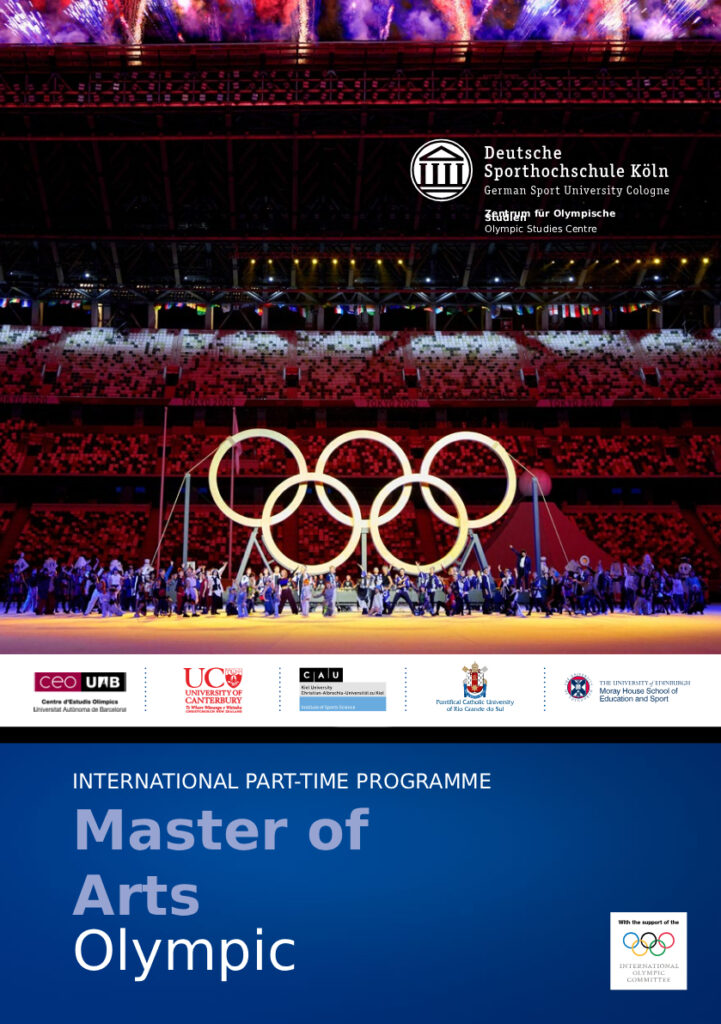
The programme has been developed by a network of universities, including the German Sport University Cologne, the University of Mainz, Loughborough University, the Autonomous University of Barcelona, and the University of Lyon. The Olympic Studies Centre (OSC) of the International Olympic Committee (IOC) has contributed to the development of the academic project.
The CEO‑UAB is responsible for the teaching module on the Olympic Games, media and commercialisation, coordinated by Dr Emilio Fernández Peña, Director of the CEO‑UAB. Through the sessions, students learn the extent to which these aspects pose a challenge to the IOC’s traditional policies and Olympic values; they understand the influence of media and commercialisation on the Olympic Movement and develop a critical perspective on commercial strategies, as well as on the media activities of the IOC, the Organising Committees for the Olympic Games (OCOGs) and the sponsors of the TOP programme. Students also examine the impact of new media on the relationships between the Olympic Movement, the media and consumers.
Programme Objectives
- To expand participants’ knowledge in the fields of social sciences and humanities in relation to Olympism.
- To promote a critical understanding of the nature and meaning of values in the advocacy and practice of Olympism, Olympic sport and the Olympic Movement.
- To encourage critical reflection on processes of continuity and transformation within the Olympic Movement, and on the relationship between Olympic practices and broader social contexts.
- To develop participants’ ability to undertake independent research in relevant areas of the Olympic Movement using appropriate methodologies.
General Curriculum Overview
The M.A. is a part-time programme with a duration of two years and four teaching periods. It consists of six teaching modules and the submission of a thesis. The modules are organised on a weekly basis (six working days per module). For each period, two weeks of on-site study are compulsory. Teaching is offered in the following modules:
Module 1: Ethics, Values and Olympic Education
Pierre de Coubertin’s Olympic idea and its relevance today, together with the ethical and cultural dimensions of Olympism, are analysed as a framework for understanding its educational and social impact.
In addition, the concepts and applications of Olympic education are addressed, including the role of the Youth Olympic Games in values education.
Module 2: Olympic Athletes and Elite Sport in Transition
The role of athletes as key actors within the Olympic Movement and their institutional positioning are analysed in relation to their rights, responsibilities, and the principles of diversity, non-discrimination and protection.
In addition, the athletes’ environment, the athlete–coach relationship, and career transition processes are examined from a holistic perspective on elite sport.
Module 3: Research Methodologies in Olympic Studies
An introduction to research methods in the humanities and social sciences, as well as to the philosophy of methodology in these fields. Both qualitative and quantitative approaches are examined, together with the main resources and tools for the study of the Olympic phenomenon (such as the Olympic World Library) and their professional application.
Module 4: Governance, Politics and Olympic Organisations
The legal and organisational structures of the Olympic system and its main institutional actors are analysed, including the Paralympic Movement, Olympism and the universal principles of good governance.
In parallel, reform agendas, anti-doping policies and contemporary challenges related to sustainability, the environment, gender equality, diversity and inclusion are addressed, as well as legacies, impacts and new trends such as virtual sports.
Module 5: Olympic Games, Media and Commercialisation
The nature and evolution of the Olympic Games as a global mega-event are examined, along with their impact on the sports and media industries, and the role, representation and experience of audiences through traditional and digital media.
In addition, dissemination, production and marketing strategies are analysed, including platforms such as the Olympic Channel, as well as trends, advantages and limitations of sponsorship and new commercial opportunities.
Module 6: International Relations and the Olympic Movement
The role of sport in international relations and the use of the Olympic phenomenon as a diplomatic tool are analysed, including the concept of the Olympic Truce.
From this perspective, political tensions within the international system are examined, such as the political use and boycotts of the Olympic Games, the role of the Olympic Movement in contexts of divided nations, and its contribution to humanitarian and development programmes in line with the Sustainable Development Goals, as well as global challenges and multiculturalism.


